Saturday, November 3, 2012

On Jee Leong Koh's "The Pillow Book"

Employing the Japanese genre of zuihitsu, Jee Leong Koh's new chapbook The Pillow Book deals with coming out, bad manners, his Singapore identity, promiscuity, the theme of delicacy in all its attendant forms, among other things. It's a beautifully designed chapbook, even sporting French flaps, for some fun, sporadically aphoristic poetry.  At one point, Koh writes, "Love is what life boils into"; he also declares, "The sun casts shadows, and so why am I surprised that love makes darkness, as if I am not in its way?"

The zuihistu can be described as a rendering of unplanned, arbitrary thoughts by the author.  You could also see it as a lot of "hyper-engaged doodling" in the best sense of the phrase.  Impacted by his Singapore and New York identity, it's a free-wheeling comic 53-page litany.  It shares the silliness of Joe Brainard's I Remember and Charles Simic's deadpan surreality.  There's a welcome abundance of pithy statement ("When someone comes home with me, there is always the question of how I will ask him to leave"), odd juxtapositions (in one list-poem, he aligns commuters who hog staircases with the small talk he has when sober), and unexpected imagery ("When I walked into McDonalds at Welshpool, the floor sucked at my sneakers.")

The only small, lingering question after reading the book is did Koh take full advantage of the open-ended form of the zuihistu?  The book is highly structured, maybe too much so, to give unequivocal respect to the form.  The majority of the entries are no longer than a page, if that, and each are given a prosaic title such as "China," "All Things," "Happiness," etc.  As a reader, you begin to want there to be even more arbitrariness.  Some of the fun that comes from the form is a careless indulgence.  Koh is careful not to let things get too out of hand.  His undeniable talent makes you crave an opportunity to look at his chapbook's rambling drafts, which, after all, is what the zuihistu, in a way, should possibly already seem to be.

Jee Leong Koh's The Pillow Book is available through Math Paper Press.


Sunday, October 28, 2012

On New Books by Cyrus Cassells, Eduardo C. Corral, and Daniel Nathan Terry

There's no denying the subject matter is an important one: the role of young people in World War II and the Holocaust.  For the most part, Cyrus Cassells' Crossed-Out Swastika tries to avoid the more obvious pitfalls: easy pathos and obvious dramatic ironies.  You can easily see why his lyric gifts have always made him so deservedly respected.  Look at his phrases: "jerry-rigged heaven," "wind-insistent Memory," "shut-mouthed God," "clerk-blessed leeks," "bliss-conferring forest," among many others.  This is his first collection in which he seems to be controlled by his subject matter; he's so nervous in being responsible that he almost sacrifices his sensual relationship with language for the tales.  For instance, in one of the longer series of poems, a mother directly addresses her son about his grandfather who was a station master during the war.  The poem ends with what in lesser hands would seem to be an unearned closure.  However, Cassells doesn't allow that to happen: "...the shouts and stones, the smashed/storefronts of Kristallnacht./How it would have angered him to see/that his beloved trains/were used to betray us."  Another small problem with the collection could be that too many of the narratives end on the same lubriguous note, a sort of romanticized despair.  At the same time, that could easily be Cassell's point.  There's a democratic sensitivity to the tales; one doesn't eclipse another--it's no coincidence that almost all the monologues are written in unrhymed couplets.  Perhaps the mild disappointment in the book is also one of its special graces: there's an ethical fidelity to the historical narratives.  It constrains, to a certain degree, Cassell's stunning lyric talents, making some of the poems, for better or worse, curiously earth-bound.

Cyrus Cassell's The Crossed-Out Swastika is available through Copper Canyon Press.

                                                     ***

In the reviews of Eduardo C. Corral's Slow Lightning, one of its awesome strengths is unarticulated: its complete refusal to make its marginalized Latino characters approachable.  The personaes in his collection are determinedly guarded, icy, and, to a large extent, unforgiving of the racism and injustices they undergo.  Perhaps the reason it took a substantial amount of time for this collection to be published is that the characters aren't looking for redemptive moments.  Thankfully, it's a strategically unfriendly collection.  One of the stand-out poems, "In Colorado My Father Scoured and Stacked the Dishes," Corral writes with representative equanimity: "He learned English/by listening to the radio. The first four words/he memorized: In God We Trust.  The fifth: Percolate."  Another great moment dealing with that same theme of language occurs in "Caballero," :"When a word stalls/on his tongue he utters,/Sufferin succotash.  Stout.  Apache-/dark.  Curious/and quick./He builds up the bridge/of his nose with clay."  So many contemporary poets perfunctorily employ litany and anaphora in their poems.  Leave it to Corral to trump most of his peers.  You can see that in an excerpt from "Self-Portrait with Tumbling and Lasso."  The narrator is a cocktease-- in the best sense of the word.  Corral writes, "I'm a ghost undressing./  I'm a cowboy/riding bareback./My soul is/whirling/above my head like a lasso./My right hand/a pistol.  My left/automatic.  I'm knocking/on every door. I'm coming on strong,/like a missionary."  Recognizing the importance of the first Latino to win the Yale Younger Poets Prize is, of course, wholly necessary.  At the same time, the book's reviewers need to find a number of additional ways of framing the aesthetic and political merits of a book that has already justifiably become canonical.  Only then will it be guarded from the inevitable, sinisterly Republican backlash.

Eduardo C. Corral's Slow Lightning is available through Yale University Press.

                                           ***

You can feel the looming presence of the conservative father-preacher figure in Daniel Nathan Terry's new book of poems Waxwings.  Occasionally working in strict forms, Terry is interested in religion, gay childhood, and its sweet, melancholy texture.  In a crown of sonnets, entitled "Snow falls in Hartsville," a story of a closeted gay teenager and his girlfriend take center stage; they fumble with their sexuality and disclose that they've both been the victims of abuse.  It's a familiar story, even if we later find out that his girlfriend later undergoes a sex change.  Without humor, the confessions involve a lot of dry discursiveness: "But nothing done to me or done to her/made us what we truly are or even most of what/we were."  Or: "leaning in/to my lover, to my life, to the wonder/of having once been a man who loved a woman/who was almost the perfect man for me."  One does get a little nervous about the connections between sexuality and incest, but there is an earnestness that almost protects the poems from such a charge.  The best parts of the book are when Terry lets loose --something no doubt his father would disapprove of.  For instance, in "Flattened Penny," Terry inflates the image of a lawn to comic hyperbolic results: "I look down at the lawn beneath my feet,/imagine it multiplying, extending to the pavement,/sprouting like hair on walls and rooftops..."

Daniel Nathan Terry's Waxwings is available through Lethe Press.

Monday, August 13, 2012

Summer Reading: Part One

My next three posts will review some of the books I read this summer.  No matter what my qualms, they inspired me to write about them.

                       ***

                          
Reveling in the power of anachronism, Matthew Hittinger's Skin Shift, his much anticipated debut book of poems, engages in a sadomasochistic relationship with myth, most spectacularly with Narcissus.  In the poem, "Concussion," Hittinger writes: "His mind arced off like a broken/rainbow, no keystone to lock indigo/or red, color scumbled into charcoal sky." It's a bit unnerving how much Hittinger is determined to aquiesce, eviscerate, and somehow even heal (with reservation) the classical stories.  This is no unequivocal tribute; there's a comic blasphemy operating in these poems.  Look at the sonic quality in "Cruising," also starring Narcissus: "His lips locked/his lips, two slivers, jaw-line jagged/edge wed to a jagged edge of light."  Yet when Hittinger disengages from myths, there's no slack, just more profundity: "What does the question/of life matter so far from the sun?"  Or in the poem, "An Orthinologist Ponders the Zenaida marcoura's Vanishing Point": "Top and bottom sit,/contemplate the long/horizon and lift off in sudden wing/whir from separate/points, flights paths spread, treasure flaps tethered, wish/bone headed to V."  Eclectic in form, yet unaffected, Hittinger creates rhyming ballads, sonnets, Sapphics, terza rima, villanelle, dramatic monologues in free verse, ghazals among others.  You can always feel Hittinger's authority in this long overdue book.  He's generous with his fictional personaes, and they, in turn, are generous back with their rhythmic declarations.  Even in a poem as expectedly slight as "Aunt Eloe Schools the Scarecrow," Hittinger finds the moral center of his character.  Her words also function as his ars poetics:  "Go back/before these stories were writ before your/tar and straw and wood and you'll find Caw loved/Howl even then, there where their forms had yet/to settle into fur and feather."

Matthew Hittinger's Skin Shift is available through Sibling Rivalry Press.


                             ***


Even if there are some tired, flat domestic poems, you can see the great promise in Ruben Quesada's wonderfully titled Next Extinct Mammal.  He's best when he deals with the issue of family in an off-handed way.  Take these nicely stated lines from "Tamale Serenade": "...I stand with Abuela facing/ the Griffith Park Observatory.  Her hair almost black/against the alien Hollywood skyline;/to our right James Dean's bronzed head ignores us."  Some other great lines appears in one of my favorites, "Photograph in Costa Rica": "Your plump face is fixed/into the lake of my occipital lobe, processed/like an unwanted cyanotype photograph, blue/and washed out against the horizon/of an empty road." Perhaps he hasn't had enough distance from the poems that feel more obviously dramatic.  When one of the narrators talk about their mother, it feels less like a poem, than a litany of biographical facts: "My mother has decided to move out,/at fifty-five. She's packed up/everything she's collected.../Her parents dead, brothers, too.  She's decided to move/father into America."  Sometimes he doesn't transform raw material, dealing with early childhood memories or moving away to college into something more exceptional.  This happens with an all-too-easy gay trope in a poem like "Memories Are Made Like This": "A clandestine kiss in a movie theatre/or a hurried fuck after leaving/work early on Friday afternoons--/even at the risk of being discovered/by the family of the man/whose love I shared--"  All in all, there's no doubt that once he gains more of a definite vision, Quesada will leap from the more conventionally domestic and launch himself into "the blue like Picasso's player" which "swells overhead, blue behind strings/of clouds..."

Ruben Quesada's Next Extinct Mammal is available through Greenhouse Review Press.


Tuesday, July 3, 2012

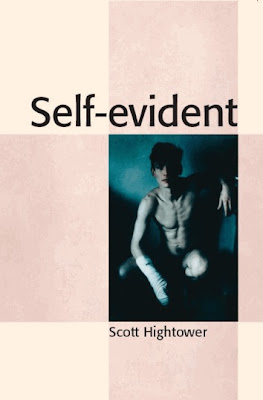
On Scott Hightower's "Self-Evident"

Always turning in clean work, Scott Hightower is someone who simultaneously is so present in the poetry scene and yet oddly almost underneath everyone's radar.  Hopefully, his new book "Self-evident" will change that.  It should.  It's always been unfortunate that several gay poets of the same generation have often been eclipsed by their peer, the ubiquitous Mark Doty.  I think that both Hightower and Doty (who is the older by a year) often share a similar temperament --a formidable strength sometimes-- and only sometimes-- accompanied by a piercing aggressiveness.  Although Doty could reasonably be said to have a finer ear, I think that it's his choice to write personal narratives that has ultimately won him much more acclaim.  Which is upsetting.   Hightower's consistent personae poems can be as deftly crafted and as personal, maybe even more so.

One of my favorite poems,  "Le Soldat Avec Les Besoins Infantiles," is largely an acute dramatic monologue in the voice of the female fairy addressed in Keats's "La Belle Dame Sans Merci."  It could almost be read as a not-too subtle critique of Hightower's choice of the dramatic monologue as a genre.  At the same time, Hightower doesn't self-deprecate to the point of a pure unnecessary dismissal.  This sort of balanced self-reflexivity embedded in the structure of the poem makes it even smarter.  Here's an excerpt:

...Afterwards, I knew
he would resort to grumbling
from some perverse shadow

of his own masochistic imagination,
that there would be a dramatic
monologue about being abandoned.

Would that he grasped that each
of us does well but to serve up
to the other the most ordinary joy!

The whole undulating world
is complete and florid,
is a single rhapsodic

motion.  And, as you
and I will know--his
own gorgeous, archaic

whiny self-indulgence
included--everywhere, there
are sweet songs worth singing....


Like Richard Howard, a good number of Hightower's poems are historical in nature.  His range is more than comprehensive.  You have no idea who he's going to choose as the next subject for a poem.  In this books, he includes filmmaker Sergei Parajanov, photographer F. Holland Day, Nobel prize-winning scientist Severo Ochoa, Casanova, and Benjamin Franklin.  And that just scratches the surface.  Ekphrastic poems also help fill the collection.

Some of my favorite poems include "Madrid, Please, Take Me; Be Mine" ("You are my Castilian/My Euskera, my Bable,/ My Pig Latin.); "There are Lecagies Beyond Land" (...I came to your granaries/ and lanes a bride, with only the dowry of poetry/ my sophistication green."); "Identity Redux" ("The wingless moon floats/beyond the encapsulating/spotlight, and each one/in the theatre must find/each's own way home."

You can feel the intellectual rigor in Hightower's interplay with high culture and history.  This initially made me standoffish-- which may be an issue of class.  Having parents who never went to college, I've perhaps always prematurely rejected poems that seem to be pushing a certain sort of academic elitism.  This is often what I see as an overdetermined desire upon the part of gay poets to prove one's own work as legitimate through incorporating a lot of history and high-cultural allusions.  Why do we need to be so well-rehearsed about the literary canon?   Let's choose our own metaphors.

But, of course, this isn't a fair critique--there's a multiple number of ways political resistance and poetic novelty can be created.  Hightower reminds us of that. And one of the things that's particularly clear about Hightower's books is that while he engages with such high-culture topics, he critiques this privilege --that's something that sets him apart.  In his smartly titled "Lately, Opening the Refrigerator" he glosses a few of the people who've died from AIDS, and then jump-cuts to sitting in the Presidential box of the Prague opera house.  He offers an appraisal ("The opera-which has never before/really quite worked for me...") and then ends describing the mise-en-scene:

...opens and closes in a garret,
two despairing choruses:
a group of grieving women,

a line of men lending
support to one another,

these broken things
of this world, this shelter.

The brilliant use of the word "shelter" and his placement of it on the final line is a small example of why Hightower is such an expert poet.  In his own poems, he takes refuge in personae and history; at the same time, openly reveling in what personal truths may come from that.  And offers those truths for-- at least for a moment-- what other, lesser poets may see as merely autobiographical "broken things."

You can receive more information about Scott Hightower's Self-evident at Barrow Street.