Sunday, October 28, 2012

On New Books by Cyrus Cassells, Eduardo C. Corral, and Daniel Nathan Terry

There's no denying the subject matter is an important one: the role of young people in World War II and the Holocaust.  For the most part, Cyrus Cassells' Crossed-Out Swastika tries to avoid the more obvious pitfalls: easy pathos and obvious dramatic ironies.  You can easily see why his lyric gifts have always made him so deservedly respected.  Look at his phrases: "jerry-rigged heaven," "wind-insistent Memory," "shut-mouthed God," "clerk-blessed leeks," "bliss-conferring forest," among many others.  This is his first collection in which he seems to be controlled by his subject matter; he's so nervous in being responsible that he almost sacrifices his sensual relationship with language for the tales.  For instance, in one of the longer series of poems, a mother directly addresses her son about his grandfather who was a station master during the war.  The poem ends with what in lesser hands would seem to be an unearned closure.  However, Cassells doesn't allow that to happen: "...the shouts and stones, the smashed/storefronts of Kristallnacht./How it would have angered him to see/that his beloved trains/were used to betray us."  Another small problem with the collection could be that too many of the narratives end on the same lubriguous note, a sort of romanticized despair.  At the same time, that could easily be Cassell's point.  There's a democratic sensitivity to the tales; one doesn't eclipse another--it's no coincidence that almost all the monologues are written in unrhymed couplets.  Perhaps the mild disappointment in the book is also one of its special graces: there's an ethical fidelity to the historical narratives.  It constrains, to a certain degree, Cassell's stunning lyric talents, making some of the poems, for better or worse, curiously earth-bound.

Cyrus Cassell's The Crossed-Out Swastika is available through Copper Canyon Press.

                                                     ***

In the reviews of Eduardo C. Corral's Slow Lightning, one of its awesome strengths is unarticulated: its complete refusal to make its marginalized Latino characters approachable.  The personaes in his collection are determinedly guarded, icy, and, to a large extent, unforgiving of the racism and injustices they undergo.  Perhaps the reason it took a substantial amount of time for this collection to be published is that the characters aren't looking for redemptive moments.  Thankfully, it's a strategically unfriendly collection.  One of the stand-out poems, "In Colorado My Father Scoured and Stacked the Dishes," Corral writes with representative equanimity: "He learned English/by listening to the radio. The first four words/he memorized: In God We Trust.  The fifth: Percolate."  Another great moment dealing with that same theme of language occurs in "Caballero," :"When a word stalls/on his tongue he utters,/Sufferin succotash.  Stout.  Apache-/dark.  Curious/and quick./He builds up the bridge/of his nose with clay."  So many contemporary poets perfunctorily employ litany and anaphora in their poems.  Leave it to Corral to trump most of his peers.  You can see that in an excerpt from "Self-Portrait with Tumbling and Lasso."  The narrator is a cocktease-- in the best sense of the word.  Corral writes, "I'm a ghost undressing./  I'm a cowboy/riding bareback./My soul is/whirling/above my head like a lasso./My right hand/a pistol.  My left/automatic.  I'm knocking/on every door. I'm coming on strong,/like a missionary."  Recognizing the importance of the first Latino to win the Yale Younger Poets Prize is, of course, wholly necessary.  At the same time, the book's reviewers need to find a number of additional ways of framing the aesthetic and political merits of a book that has already justifiably become canonical.  Only then will it be guarded from the inevitable, sinisterly Republican backlash.

Eduardo C. Corral's Slow Lightning is available through Yale University Press.

                                           ***

You can feel the looming presence of the conservative father-preacher figure in Daniel Nathan Terry's new book of poems Waxwings.  Occasionally working in strict forms, Terry is interested in religion, gay childhood, and its sweet, melancholy texture.  In a crown of sonnets, entitled "Snow falls in Hartsville," a story of a closeted gay teenager and his girlfriend take center stage; they fumble with their sexuality and disclose that they've both been the victims of abuse.  It's a familiar story, even if we later find out that his girlfriend later undergoes a sex change.  Without humor, the confessions involve a lot of dry discursiveness: "But nothing done to me or done to her/made us what we truly are or even most of what/we were."  Or: "leaning in/to my lover, to my life, to the wonder/of having once been a man who loved a woman/who was almost the perfect man for me."  One does get a little nervous about the connections between sexuality and incest, but there is an earnestness that almost protects the poems from such a charge.  The best parts of the book are when Terry lets loose --something no doubt his father would disapprove of.  For instance, in "Flattened Penny," Terry inflates the image of a lawn to comic hyperbolic results: "I look down at the lawn beneath my feet,/imagine it multiplying, extending to the pavement,/sprouting like hair on walls and rooftops..."

Daniel Nathan Terry's Waxwings is available through Lethe Press.

Monday, August 13, 2012

Summer Reading: Part One

My next three posts will review some of the books I read this summer.  No matter what my qualms, they inspired me to write about them.

                       ***

                          
Reveling in the power of anachronism, Matthew Hittinger's Skin Shift, his much anticipated debut book of poems, engages in a sadomasochistic relationship with myth, most spectacularly with Narcissus.  In the poem, "Concussion," Hittinger writes: "His mind arced off like a broken/rainbow, no keystone to lock indigo/or red, color scumbled into charcoal sky." It's a bit unnerving how much Hittinger is determined to aquiesce, eviscerate, and somehow even heal (with reservation) the classical stories.  This is no unequivocal tribute; there's a comic blasphemy operating in these poems.  Look at the sonic quality in "Cruising," also starring Narcissus: "His lips locked/his lips, two slivers, jaw-line jagged/edge wed to a jagged edge of light."  Yet when Hittinger disengages from myths, there's no slack, just more profundity: "What does the question/of life matter so far from the sun?"  Or in the poem, "An Orthinologist Ponders the Zenaida marcoura's Vanishing Point": "Top and bottom sit,/contemplate the long/horizon and lift off in sudden wing/whir from separate/points, flights paths spread, treasure flaps tethered, wish/bone headed to V."  Eclectic in form, yet unaffected, Hittinger creates rhyming ballads, sonnets, Sapphics, terza rima, villanelle, dramatic monologues in free verse, ghazals among others.  You can always feel Hittinger's authority in this long overdue book.  He's generous with his fictional personaes, and they, in turn, are generous back with their rhythmic declarations.  Even in a poem as expectedly slight as "Aunt Eloe Schools the Scarecrow," Hittinger finds the moral center of his character.  Her words also function as his ars poetics:  "Go back/before these stories were writ before your/tar and straw and wood and you'll find Caw loved/Howl even then, there where their forms had yet/to settle into fur and feather."

Matthew Hittinger's Skin Shift is available through Sibling Rivalry Press.


                             ***


Even if there are some tired, flat domestic poems, you can see the great promise in Ruben Quesada's wonderfully titled Next Extinct Mammal.  He's best when he deals with the issue of family in an off-handed way.  Take these nicely stated lines from "Tamale Serenade": "...I stand with Abuela facing/ the Griffith Park Observatory.  Her hair almost black/against the alien Hollywood skyline;/to our right James Dean's bronzed head ignores us."  Some other great lines appears in one of my favorites, "Photograph in Costa Rica": "Your plump face is fixed/into the lake of my occipital lobe, processed/like an unwanted cyanotype photograph, blue/and washed out against the horizon/of an empty road." Perhaps he hasn't had enough distance from the poems that feel more obviously dramatic.  When one of the narrators talk about their mother, it feels less like a poem, than a litany of biographical facts: "My mother has decided to move out,/at fifty-five. She's packed up/everything she's collected.../Her parents dead, brothers, too.  She's decided to move/father into America."  Sometimes he doesn't transform raw material, dealing with early childhood memories or moving away to college into something more exceptional.  This happens with an all-too-easy gay trope in a poem like "Memories Are Made Like This": "A clandestine kiss in a movie theatre/or a hurried fuck after leaving/work early on Friday afternoons--/even at the risk of being discovered/by the family of the man/whose love I shared--"  All in all, there's no doubt that once he gains more of a definite vision, Quesada will leap from the more conventionally domestic and launch himself into "the blue like Picasso's player" which "swells overhead, blue behind strings/of clouds..."

Ruben Quesada's Next Extinct Mammal is available through Greenhouse Review Press.


Tuesday, July 3, 2012

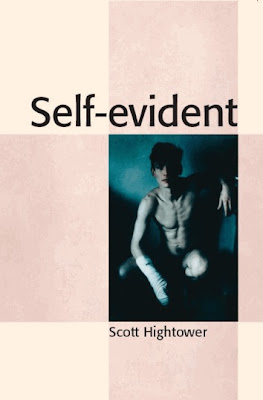
On Scott Hightower's "Self-Evident"

Always turning in clean work, Scott Hightower is someone who simultaneously is so present in the poetry scene and yet oddly almost underneath everyone's radar.  Hopefully, his new book "Self-evident" will change that.  It should.  It's always been unfortunate that several gay poets of the same generation have often been eclipsed by their peer, the ubiquitous Mark Doty.  I think that both Hightower and Doty (who is the older by a year) often share a similar temperament --a formidable strength sometimes-- and only sometimes-- accompanied by a piercing aggressiveness.  Although Doty could reasonably be said to have a finer ear, I think that it's his choice to write personal narratives that has ultimately won him much more acclaim.  Which is upsetting.   Hightower's consistent personae poems can be as deftly crafted and as personal, maybe even more so.

One of my favorite poems,  "Le Soldat Avec Les Besoins Infantiles," is largely an acute dramatic monologue in the voice of the female fairy addressed in Keats's "La Belle Dame Sans Merci."  It could almost be read as a not-too subtle critique of Hightower's choice of the dramatic monologue as a genre.  At the same time, Hightower doesn't self-deprecate to the point of a pure unnecessary dismissal.  This sort of balanced self-reflexivity embedded in the structure of the poem makes it even smarter.  Here's an excerpt:

...Afterwards, I knew
he would resort to grumbling
from some perverse shadow

of his own masochistic imagination,
that there would be a dramatic
monologue about being abandoned.

Would that he grasped that each
of us does well but to serve up
to the other the most ordinary joy!

The whole undulating world
is complete and florid,
is a single rhapsodic

motion.  And, as you
and I will know--his
own gorgeous, archaic

whiny self-indulgence
included--everywhere, there
are sweet songs worth singing....


Like Richard Howard, a good number of Hightower's poems are historical in nature.  His range is more than comprehensive.  You have no idea who he's going to choose as the next subject for a poem.  In this books, he includes filmmaker Sergei Parajanov, photographer F. Holland Day, Nobel prize-winning scientist Severo Ochoa, Casanova, and Benjamin Franklin.  And that just scratches the surface.  Ekphrastic poems also help fill the collection.

Some of my favorite poems include "Madrid, Please, Take Me; Be Mine" ("You are my Castilian/My Euskera, my Bable,/ My Pig Latin.); "There are Lecagies Beyond Land" (...I came to your granaries/ and lanes a bride, with only the dowry of poetry/ my sophistication green."); "Identity Redux" ("The wingless moon floats/beyond the encapsulating/spotlight, and each one/in the theatre must find/each's own way home."

You can feel the intellectual rigor in Hightower's interplay with high culture and history.  This initially made me standoffish-- which may be an issue of class.  Having parents who never went to college, I've perhaps always prematurely rejected poems that seem to be pushing a certain sort of academic elitism.  This is often what I see as an overdetermined desire upon the part of gay poets to prove one's own work as legitimate through incorporating a lot of history and high-cultural allusions.  Why do we need to be so well-rehearsed about the literary canon?   Let's choose our own metaphors.

But, of course, this isn't a fair critique--there's a multiple number of ways political resistance and poetic novelty can be created.  Hightower reminds us of that. And one of the things that's particularly clear about Hightower's books is that while he engages with such high-culture topics, he critiques this privilege --that's something that sets him apart.  In his smartly titled "Lately, Opening the Refrigerator" he glosses a few of the people who've died from AIDS, and then jump-cuts to sitting in the Presidential box of the Prague opera house.  He offers an appraisal ("The opera-which has never before/really quite worked for me...") and then ends describing the mise-en-scene:

...opens and closes in a garret,
two despairing choruses:
a group of grieving women,

a line of men lending
support to one another,

these broken things
of this world, this shelter.

The brilliant use of the word "shelter" and his placement of it on the final line is a small example of why Hightower is such an expert poet.  In his own poems, he takes refuge in personae and history; at the same time, openly reveling in what personal truths may come from that.  And offers those truths for-- at least for a moment-- what other, lesser poets may see as merely autobiographical "broken things."

You can receive more information about Scott Hightower's Self-evident at Barrow Street.

Thursday, May 24, 2012

On Jameson Fitzpatrick, Eduardo C. Corral, Alex Dimitrov, and the Lambda Literary Review

In a creepy faux analysis of Anne Sexton, Jameson Fitzpatrick's article entitled "Anne Sexton, Aesthetics, and the Economy of Beauty" deflects larger issues of race and power in the gay male community in favor of decontextualizing the published words of poet, Eduardo C. Corral, for more questionable ends.  I hope that the Lambda Literary review offers a corrective to an article that could be seen as a (clumsy) racialized attack against Corral.

It must be noted that you feel Fitzpatrick's eager desire to ditch talking about Anne Sexton, his "favorite" poet, and discuss about what he sees as larger issues (ie Eduardo C. Corral).  In fact, the entire article acts as a vehicle to express his self-confessed fear that the poetry world may be ruined by talking about appearance and by extension whiteness.   He uses the typical codified language to make the issue of race completely present and invisible at the same time: "beauty," "style," "substance," among other things.  Whether or not Fitzpatrick believes Corral's book Slow Lightning is "bold and imaginative" (which he tellingly puts in parenthesis) is insignificant.  But it is amusing that he conflates Sexton with Dimitrov: "...her gift as a writer remains singular and irrefutable.  Likewise, Dimitrov (his attractiveness aside), writes tight, honest poems...Dimitrov is writing some of the most exciting poems today."  It's comforting to know that "poetry's next great gay hope" (as stated by Out magazine) is already canonized without even having published a book.  But a poet, the first Latino who has won the Yale Younger Poet Prize, according to Fitzpatrick, is doing an admirable job, which receives a quick gloss.

What's predictable is that the way the article is structured.  Fitzpatrick's closing argument is that Dimitrov's poems are "some of the most exciting poetry today."  And we also have to receive this final imperative: "That he is young and pretty shouldn't count against him."

Who is attacking Dimitrov's beauty?  Who even named Dimitrov in print?  Certainly it wasn't Corral: there's no mention specifically of Dimitrov in the interview that launched this attack.

Here's Corral's words in the Plougshares interview:

"The queer poetry community in New York City is full of beautiful people, which makes me an outsider…I’m disappointed in many of my queer peers. So many of them want to be part of the hipster crowd. So many of them value looks over talent. The cool kids form clubs, become gatekeepers. So many of my peers are clamoring to be let in."

Although never explicitly named, Corral may be talking about more than "weight" (as he does name in the Ploughshares interview) and "cool"-ness.   He's referring to the whiteness of the poetry scene.  He has mentioned in a variety of interviews about the marginalization of Latino poets in the white publishing world.  There's no way Fitzpatrick could not have seen that--he admits to having read the numerous articles about Dimitrov.  He no doubtedly may have scanned a few of Corral's unless he was too taken by Dimitrov's beauty.  Is there really any other way to translate Fitzpatrick's "bristling" at Corral's "experience of his exclusion" as a dismissal of the subject of race?

By pulling Corral's quotation, as Fitzpatrick does, especially decontextualizing it from other interviews and articles (he lists Dimitrov's entire CV),  he makes it seem like Corral's a self-hating Latino who wishes he was as good looking as the rest of the Wilde (white) boys.  I think that Corral's comment in the initial interview was much more nuanced in context and unaggressive--he doesn't name names.  At the same time, it isn't self-pitying.  There's a delicate balance there.

I think the issue of who is naming (Fitzpatrick) and who isn't (Corral) reveals the racial inequalities as well.  No matter how successful a Latino is, he always feels the pressure to be polite, be unaggressive, to not name as a result of power structures and individualized racial presumptions.  But the unknown white guy can swoop in and say whatever he wants and gain credibility and access to the conversation without any self-consciousness, all in the desire to claim truth and beauty.

I am not in any way claiming that Fitzpatrick is racist.  I don't know him.  I don't know Dimitrov.  I don't know Corral.  I've never met them in person.  The point is this: what may be a complete lack of self-interrogation on Fitzpatrick's part is reflective of the failure of white men to discuss the matrices of race and the publishing world.

But this article also points to the troubling nature of the Lambda Literary organization: they make token gestures towards racial equality, but, in a lot of ways, affirm a glass ceiling for gay writers of color.  You can see it in the nominations this year.  They need to solve the problem.  One of those ways is to immediately create a symposium directly dealing with these urgent issues.

Wednesday, May 2, 2012

On Eileen Myles' "Snowflake/different streets"


You can't help but be somewhat rattled by poet Eileen Myles' audacity to write such short lines --often consisting of just two or three words-- in a column that scrolls down page after page, and sometimes, even another page after that.  Why not combine a few more words on the same line and make the poem a bit shorter?  It'll save space and trees.  Her refusal to be economical is obnoxious.  And in a gendered sense, almost completely necessary.  She's so admirably greedy when it comes to taking up space.  The length of her poems show that to us; they push against the daintiness of the singular lines.  It's unforgivable excess, indispensable lesbian melodrama.  Thank you, Eileen.

I'm always exasperated when I read a new book by Myles, one of the three greatest living poets.   Her new dual volume Snowflake/different streets reminds me that great art should make you feel suspicious; like you feel they're getting one past you.  It's not just the fact that Myles can seem like she's cheating with her palpable absence of words.  (What's her advice to her students?  If you write three words a day, you'll have a full-length book in two months.)  What's equally bothersome is the words themselves: they're a lot of the time monosyllabic.

Perhaps we should see Myles' ars poeticas as confessions. Here's a wonderfully rude poem called "#11 The Lines" in its entirety:

We're both here
in the dark and I can't
feel you

I don't know what
you're saying

just stay in your
lines

I'm surprised that Myles didn't divy up the final line into two: "li-" followed by "nes."  Or maybe I'm not surprised.  She's not that nice.  She's not aiming for gravitas.  She's not simply being cranky.  She's not above getting bored with us.  Myles and her readers might both be "here," "in" the poem, but by the end, she's nothing more than a nasty imperative, and we're left holding her words, those burdensome lines.  She's aware of how much they weigh.  She can't/won't carry them any further; that's why she drops them; the lines lie there, flat and attenuated; that's why she seems to takes off and doesn't look back.

The narrowness of her work in these two volumes is something that challenges the conventions of autobiographical poetry.  She doesn't make the mundane beautiful; she makes the mundane even more mundane--that's where so much of the excitement lies.  She's going to share no matter what, even if it's her boredom with herself.  In the poem, "My Monster" she begins with a fun observation that feels simply made to push her toward writing:

dry cleaners
never
have to
worry
about their
sign

the worse
it gets
the cleaner
people think
their
clothes
will be

Myles is too amazing of a poet to even attempt to ride on her own wittiness--she knows that  when you say something so cool, there's no other thing to really do except be tired.  Why continue trying to outdo yourself?  How many smart things can someone say in a day?  Or a month?  Or even a whole goddamned year?  Who can keep things going, and who wants to?   Myles makes the inevitability of intellectual fatigue cool.

The poem happily descends into this sort of peculiarity:

just when
I had
nothing
to say
I heard
his blah blah
blah
and I thought
well I'll
say something
else

I want
to be
in it

you might

think
I'm ignoring
you but
that's what's happening

And look at this great opening from the poem  "Transportation':

I bought a bigger
pinker dick
for you
but then I
didn't
call.  It seemed necessary
you're tall
& I miss you all
the time.

As if the sight gag of the "bigger" --Myles is the queen of the mock qualifiers-- isn't enough, the line breaks amp up the comedy even more.  Within thirteen words, six and almost one half lines, she gives a gift to her beloved, takes it back, and ditches her completely.  That isn't even the best part of it.

Here's the rub: the placement of "you're tall" in a line all by itself.  It's something that is implicit in the preceding lines---another useless qualification, but the sudden need to state feels dumb and by extension loving.  Myles might disappear from the relationship, but she still sees her.  Myles can't help herself: the jarring line breaks express a double take of sorts, and isn't that what we all want from our lovers?  As well as our poems?  To make us belief that something of our essence, no matter how insignificant, can still catch someone off guard, even when the whole stupid thing is over?

If you look at this amazing dual collection as more or less a series of ars poeticas strung together with funny anecdotes about girlfriends, and places, and miscellaneous wit,  it all begins to make even more sense.  As she says in the poem "your name," "Aren't/we lucky to have/captured each/other in this/hideous neon light."  It should be obvious that she doesn't phrase it as a question.  She doesn't even need to hear our yes.

You can receive information about  Eileen Myles' Snowflake/different streets at Wave Books.


Sunday, April 8, 2012

On Rigoberto Gonzalez's Poem "Our Deportees" in the March/April Issue of The American Poetry Review


The eerie thing about Rigoberto Gonzalez's poem "Our Deportees" in the current March/April issue of The American Poetry Review is the names of particular immigrants are almost never invoked.  There's one brief stanza about a common burial that lists some in the most cursory manner.  But that's it.  This is a poem that boldly refuses to use narrative in the conventional sense; we aren't given particular plights of particular victims.  The United States' treatment of illegal immigrants needs more attention than a litany of faceless entities, according to Gonzalez's poem.  By surveying the entire world --from a single apple tree to the path of a red-tailed hawk to strange flowers "with no petals" --he effectively illustrates how the entire fabric of the world is harmed through the persecution of immigrants.  Through Gonzalez's trademark of jam-packing stanzas with a particular figurative device--in this case, most often personification--he succeeds in creating what may be the best poem I've read in the last couple months.  Let's hope it doesn't get overlooked when the inclusions for Best American Poetry and Pushcart Prize volumes are finalized.  Along with Jee Leong Koh, he was already robbed of a Lambda nomination.

Gonzalez's six-sectioned poem deals explicitly with the bleak trajectory of the illegal immigrants.  Each section receives a name: "after the immigration raid," "after the ride by bus," "after the detention in the county jail," "after the deportation plane falls from the sky," "after the clean-up along Los Gatos Canyon," "after the communal burial."

The poem introduces itself on the smallest scale: "Beneath one apple tree the fruit/lies flung like the beads from/a rosary with the broken string" By the end of the poem, that "one" transforms itself into something immeasurable.  At the same time, the poem quietly enacts its own comprehensiveness: "Twenty-eight equals one/deportation bus equals one/cell in the detention center, one/plane-load of deportees, one/plunge into the canyon..."

Not to mention that "one," throughout the course of the poem, extends itself beyond the human, and beyond the natural, and into the inanimate,  into the lives of our objects.. With all the personification, you'd expect the poem to begin to sound like a Disney World theme park, but it's goal is to convey how this horror affects every fiber of spiritual being and mortal creation.  Everything is corrupted, even the bus that transports the immigrants.  As Gonzalez writes, "The bus makes believe/no one cried into their hands and smeared/that grief into its walls."  And then later: "The bus breathes out the shapes/turned silhouettes turned scent/of salt and sweat."

Perhaps the most expert use of personification occurs in the section "after the deportation plane falls from the sky."  I thought of James L. Dickey's pre-9/11 poem "Falling" from the 70s that dealt with a different sort of airline tragedy.  The latter deals with a non-fictional account of stewardess who fell to her death after being sucked out of the airplane's door.  The poem scrawls all over the page with long, exhaustive lines, which includes one like this: "screaming without enough air/still neat  lipsticked  stockinged  girdled by regulation/her hat still on...in all her dance-dark weight/coming down from a marvelous leap..."  Here Gonzalez describes the act through negation: "A red-tailed hawk breaks through/the smoke and doesn't drop the way/the bodies did when the plane/began to dive and spat pieces of its/cargo out the door."   Gonzalez offer an antithesis to Dickey's crazy romanticism of death.  As he writes, "No grace, the twitching/of such a great machine.  No beauty to/its blackening inside the pristine/canvas of majestic blue--a streak of rage/made with a torch and not a paintbrush."  Those lines serve as an ars poetica--Gonzalez is uninterested in a false romantic nature of the tragedy.

 In the final stanza of the poem,  within the section entitled "after the communal burial," he uses an exclamatory didacticism: "This is the place to forget/about labor and hardship and pain./No house left to build,no kitchen/to clean, no chair on a  porch, no/children to feed."  This sort of move makes a poem like "Our Deportees" truly risky--a work that is too often used.  Here though it's completely earned.  With the nation's failure in dealing with the role of immigrants, didacticism is needed.  Without apology, Gonzalez informs us that there is, indeed:

...No longing left
except a wish that will never come
true: Paint us back into the blank
sky's blue.  Don't forget us
like we've forgotten all of you. 

Information about the March/April 2012 edition of The American Poetry Review can be found at https://www.aprweb.org/