Tuesday, January 22, 2013

Microreviews: Bryan Borland's "Less Fortunate Pirates" and Aaron Smith's "Appetite"

Generosity can be an unfortunate trait in the poetry world.  One of the most exciting new presses, Sibling Rivalry Press, was created by Bryan Borland; he's already brought so much attention to poets like first book authors such as Saeed Jones and Matthew Hittinger as well as veterans like Michael Klein.  In his constant drive to help others, his own new sincere, edifying book, Less Unfortunate Pirates: Poems from the First Year Without My Father, has somehow slipped through the cracks.  It's an elegy to his father.  The story behind his press is simple: Bryan wanted a published book of poetry, asked his father, who gave him $1000 to do so.  This money was used to put his own book in the world, and, by extension, the press.  One could view Borland's book as not only touching remembrances of his father, but also, a poetic explanation of what motivated him to establish his own reputation as a poet and community leader.  Unashamedly straightforward, Borland declares in one of his best poems "The Day I Find My Father's Lost Wedding Ring": "I slide it on and it fits./Suddenly we are linked by numbers/and gold, size-seven fingers and thirty years..."  One cannot help but see this conflation of identities as a precursor to the exchange that resulted in his own vibrant career.  Very rarely does Borland stretch the pirate conceit too much, and even when he does, it feels almost justified; he's trying to make sense of his own confusing relationship with his father through forcing it into a unified narrative.  He's aware of the inherent awkwardnesses of such a project.  As he quite effectively writes, "I refuse to keep you in boxes/or hanging in guestroom closets the way/my mother holds onto my brother,/but isn't it the same that I pour your ashes/into unmetered verse?"

Bryan Borland's Less Fortunate Pirates is available through Sibling Rivalry Press.


                                                ***


In a way, Aaron Smith's second full-length book collection, Appetite, is essentially a repackaging of his very fun, wonderful chapbook Men in Groups.  This choice to make Appetite an extension of the chapbook rather than create something entirely new yields a limitation or two.  A few of  his additions feel dated: "The Problem with Straight People (What We Say Behind Your Back)," for instance, deals with gay rage, detailing the almost comic transcriptions of his friend's thoughts: "Brandon on the phone: We should start straight bashing.  Find an asshole straight guy and beat him with a bad,/ fuck him in the ass."  The centerpiece of the book consists of a prosaic litany of his favorite parts of movies.  It lasts eight pages; he sometimes relies on the easy joke: "I love the part in Watchmen where Patrick Wilson is naked.  I love the part in Hard Candy where Patrick Wilson is naked.  I love the part in Passengers where Patrick Wilson is naked."  The most memorable ones contain, to his credit, the most gutsy, depraved humor: "My friend Matt admitted he jerked off to the rape scene in The Accused: 'I knew she wasn't really being raped, and that one guy had a nice ass.'"  The flat deadpan here works great.  There are no apologies; Smith is good at being thoughtless and mean.  It's his self-conscious that can from time to time deflate his own comic set-ups.  A few of best poems here do come from the chapbook: "Diesel Clothing Ad (Naked Man with Messenger Bag)), "Fat Ass," and "Hurtful."  With this book-length collection, you have to hunt around for them a little bit, rather than in the chapbook, they would pop up almost immediately.  There's nothing anorexic about a chapbook; it can be a beautiful thing in and of itself.

Aaron Smith's Appetite is available through University of Pittsburgh Press.


Saturday, November 3, 2012

On Jee Leong Koh's "The Pillow Book"

Employing the Japanese genre of zuihitsu, Jee Leong Koh's new chapbook The Pillow Book deals with coming out, bad manners, his Singapore identity, promiscuity, the theme of delicacy in all its attendant forms, among other things. It's a beautifully designed chapbook, even sporting French flaps, for some fun, sporadically aphoristic poetry.  At one point, Koh writes, "Love is what life boils into"; he also declares, "The sun casts shadows, and so why am I surprised that love makes darkness, as if I am not in its way?"

The zuihistu can be described as a rendering of unplanned, arbitrary thoughts by the author.  You could also see it as a lot of "hyper-engaged doodling" in the best sense of the phrase.  Impacted by his Singapore and New York identity, it's a free-wheeling comic 53-page litany.  It shares the silliness of Joe Brainard's I Remember and Charles Simic's deadpan surreality.  There's a welcome abundance of pithy statement ("When someone comes home with me, there is always the question of how I will ask him to leave"), odd juxtapositions (in one list-poem, he aligns commuters who hog staircases with the small talk he has when sober), and unexpected imagery ("When I walked into McDonalds at Welshpool, the floor sucked at my sneakers.")

The only small, lingering question after reading the book is did Koh take full advantage of the open-ended form of the zuihistu?  The book is highly structured, maybe too much so, to give unequivocal respect to the form.  The majority of the entries are no longer than a page, if that, and each are given a prosaic title such as "China," "All Things," "Happiness," etc.  As a reader, you begin to want there to be even more arbitrariness.  Some of the fun that comes from the form is a careless indulgence.  Koh is careful not to let things get too out of hand.  His undeniable talent makes you crave an opportunity to look at his chapbook's rambling drafts, which, after all, is what the zuihistu, in a way, should possibly already seem to be.

Jee Leong Koh's The Pillow Book is available through Math Paper Press.


Sunday, October 28, 2012

On New Books by Cyrus Cassells, Eduardo C. Corral, and Daniel Nathan Terry

There's no denying the subject matter is an important one: the role of young people in World War II and the Holocaust.  For the most part, Cyrus Cassells' Crossed-Out Swastika tries to avoid the more obvious pitfalls: easy pathos and obvious dramatic ironies.  You can easily see why his lyric gifts have always made him so deservedly respected.  Look at his phrases: "jerry-rigged heaven," "wind-insistent Memory," "shut-mouthed God," "clerk-blessed leeks," "bliss-conferring forest," among many others.  This is his first collection in which he seems to be controlled by his subject matter; he's so nervous in being responsible that he almost sacrifices his sensual relationship with language for the tales.  For instance, in one of the longer series of poems, a mother directly addresses her son about his grandfather who was a station master during the war.  The poem ends with what in lesser hands would seem to be an unearned closure.  However, Cassells doesn't allow that to happen: "...the shouts and stones, the smashed/storefronts of Kristallnacht./How it would have angered him to see/that his beloved trains/were used to betray us."  Another small problem with the collection could be that too many of the narratives end on the same lubriguous note, a sort of romanticized despair.  At the same time, that could easily be Cassell's point.  There's a democratic sensitivity to the tales; one doesn't eclipse another--it's no coincidence that almost all the monologues are written in unrhymed couplets.  Perhaps the mild disappointment in the book is also one of its special graces: there's an ethical fidelity to the historical narratives.  It constrains, to a certain degree, Cassell's stunning lyric talents, making some of the poems, for better or worse, curiously earth-bound.

Cyrus Cassell's The Crossed-Out Swastika is available through Copper Canyon Press.

                                                     ***

In the reviews of Eduardo C. Corral's Slow Lightning, one of its awesome strengths is unarticulated: its complete refusal to make its marginalized Latino characters approachable.  The personaes in his collection are determinedly guarded, icy, and, to a large extent, unforgiving of the racism and injustices they undergo.  Perhaps the reason it took a substantial amount of time for this collection to be published is that the characters aren't looking for redemptive moments.  Thankfully, it's a strategically unfriendly collection.  One of the stand-out poems, "In Colorado My Father Scoured and Stacked the Dishes," Corral writes with representative equanimity: "He learned English/by listening to the radio. The first four words/he memorized: In God We Trust.  The fifth: Percolate."  Another great moment dealing with that same theme of language occurs in "Caballero," :"When a word stalls/on his tongue he utters,/Sufferin succotash.  Stout.  Apache-/dark.  Curious/and quick./He builds up the bridge/of his nose with clay."  So many contemporary poets perfunctorily employ litany and anaphora in their poems.  Leave it to Corral to trump most of his peers.  You can see that in an excerpt from "Self-Portrait with Tumbling and Lasso."  The narrator is a cocktease-- in the best sense of the word.  Corral writes, "I'm a ghost undressing./  I'm a cowboy/riding bareback./My soul is/whirling/above my head like a lasso./My right hand/a pistol.  My left/automatic.  I'm knocking/on every door. I'm coming on strong,/like a missionary."  Recognizing the importance of the first Latino to win the Yale Younger Poets Prize is, of course, wholly necessary.  At the same time, the book's reviewers need to find a number of additional ways of framing the aesthetic and political merits of a book that has already justifiably become canonical.  Only then will it be guarded from the inevitable, sinisterly Republican backlash.

Eduardo C. Corral's Slow Lightning is available through Yale University Press.

                                           ***

You can feel the looming presence of the conservative father-preacher figure in Daniel Nathan Terry's new book of poems Waxwings.  Occasionally working in strict forms, Terry is interested in religion, gay childhood, and its sweet, melancholy texture.  In a crown of sonnets, entitled "Snow falls in Hartsville," a story of a closeted gay teenager and his girlfriend take center stage; they fumble with their sexuality and disclose that they've both been the victims of abuse.  It's a familiar story, even if we later find out that his girlfriend later undergoes a sex change.  Without humor, the confessions involve a lot of dry discursiveness: "But nothing done to me or done to her/made us what we truly are or even most of what/we were."  Or: "leaning in/to my lover, to my life, to the wonder/of having once been a man who loved a woman/who was almost the perfect man for me."  One does get a little nervous about the connections between sexuality and incest, but there is an earnestness that almost protects the poems from such a charge.  The best parts of the book are when Terry lets loose --something no doubt his father would disapprove of.  For instance, in "Flattened Penny," Terry inflates the image of a lawn to comic hyperbolic results: "I look down at the lawn beneath my feet,/imagine it multiplying, extending to the pavement,/sprouting like hair on walls and rooftops..."

Daniel Nathan Terry's Waxwings is available through Lethe Press.

Monday, August 13, 2012

Summer Reading: Part One

My next three posts will review some of the books I read this summer.  No matter what my qualms, they inspired me to write about them.

                       ***

                          
Reveling in the power of anachronism, Matthew Hittinger's Skin Shift, his much anticipated debut book of poems, engages in a sadomasochistic relationship with myth, most spectacularly with Narcissus.  In the poem, "Concussion," Hittinger writes: "His mind arced off like a broken/rainbow, no keystone to lock indigo/or red, color scumbled into charcoal sky." It's a bit unnerving how much Hittinger is determined to aquiesce, eviscerate, and somehow even heal (with reservation) the classical stories.  This is no unequivocal tribute; there's a comic blasphemy operating in these poems.  Look at the sonic quality in "Cruising," also starring Narcissus: "His lips locked/his lips, two slivers, jaw-line jagged/edge wed to a jagged edge of light."  Yet when Hittinger disengages from myths, there's no slack, just more profundity: "What does the question/of life matter so far from the sun?"  Or in the poem, "An Orthinologist Ponders the Zenaida marcoura's Vanishing Point": "Top and bottom sit,/contemplate the long/horizon and lift off in sudden wing/whir from separate/points, flights paths spread, treasure flaps tethered, wish/bone headed to V."  Eclectic in form, yet unaffected, Hittinger creates rhyming ballads, sonnets, Sapphics, terza rima, villanelle, dramatic monologues in free verse, ghazals among others.  You can always feel Hittinger's authority in this long overdue book.  He's generous with his fictional personaes, and they, in turn, are generous back with their rhythmic declarations.  Even in a poem as expectedly slight as "Aunt Eloe Schools the Scarecrow," Hittinger finds the moral center of his character.  Her words also function as his ars poetics:  "Go back/before these stories were writ before your/tar and straw and wood and you'll find Caw loved/Howl even then, there where their forms had yet/to settle into fur and feather."

Matthew Hittinger's Skin Shift is available through Sibling Rivalry Press.


                             ***


Even if there are some tired, flat domestic poems, you can see the great promise in Ruben Quesada's wonderfully titled Next Extinct Mammal.  He's best when he deals with the issue of family in an off-handed way.  Take these nicely stated lines from "Tamale Serenade": "...I stand with Abuela facing/ the Griffith Park Observatory.  Her hair almost black/against the alien Hollywood skyline;/to our right James Dean's bronzed head ignores us."  Some other great lines appears in one of my favorites, "Photograph in Costa Rica": "Your plump face is fixed/into the lake of my occipital lobe, processed/like an unwanted cyanotype photograph, blue/and washed out against the horizon/of an empty road." Perhaps he hasn't had enough distance from the poems that feel more obviously dramatic.  When one of the narrators talk about their mother, it feels less like a poem, than a litany of biographical facts: "My mother has decided to move out,/at fifty-five. She's packed up/everything she's collected.../Her parents dead, brothers, too.  She's decided to move/father into America."  Sometimes he doesn't transform raw material, dealing with early childhood memories or moving away to college into something more exceptional.  This happens with an all-too-easy gay trope in a poem like "Memories Are Made Like This": "A clandestine kiss in a movie theatre/or a hurried fuck after leaving/work early on Friday afternoons--/even at the risk of being discovered/by the family of the man/whose love I shared--"  All in all, there's no doubt that once he gains more of a definite vision, Quesada will leap from the more conventionally domestic and launch himself into "the blue like Picasso's player" which "swells overhead, blue behind strings/of clouds..."

Ruben Quesada's Next Extinct Mammal is available through Greenhouse Review Press.


Tuesday, July 3, 2012

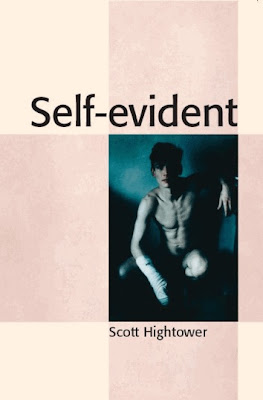
On Scott Hightower's "Self-Evident"

Always turning in clean work, Scott Hightower is someone who simultaneously is so present in the poetry scene and yet oddly almost underneath everyone's radar.  Hopefully, his new book "Self-evident" will change that.  It should.  It's always been unfortunate that several gay poets of the same generation have often been eclipsed by their peer, the ubiquitous Mark Doty.  I think that both Hightower and Doty (who is the older by a year) often share a similar temperament --a formidable strength sometimes-- and only sometimes-- accompanied by a piercing aggressiveness.  Although Doty could reasonably be said to have a finer ear, I think that it's his choice to write personal narratives that has ultimately won him much more acclaim.  Which is upsetting.   Hightower's consistent personae poems can be as deftly crafted and as personal, maybe even more so.

One of my favorite poems,  "Le Soldat Avec Les Besoins Infantiles," is largely an acute dramatic monologue in the voice of the female fairy addressed in Keats's "La Belle Dame Sans Merci."  It could almost be read as a not-too subtle critique of Hightower's choice of the dramatic monologue as a genre.  At the same time, Hightower doesn't self-deprecate to the point of a pure unnecessary dismissal.  This sort of balanced self-reflexivity embedded in the structure of the poem makes it even smarter.  Here's an excerpt:

...Afterwards, I knew
he would resort to grumbling
from some perverse shadow

of his own masochistic imagination,
that there would be a dramatic
monologue about being abandoned.

Would that he grasped that each
of us does well but to serve up
to the other the most ordinary joy!

The whole undulating world
is complete and florid,
is a single rhapsodic

motion.  And, as you
and I will know--his
own gorgeous, archaic

whiny self-indulgence
included--everywhere, there
are sweet songs worth singing....


Like Richard Howard, a good number of Hightower's poems are historical in nature.  His range is more than comprehensive.  You have no idea who he's going to choose as the next subject for a poem.  In this books, he includes filmmaker Sergei Parajanov, photographer F. Holland Day, Nobel prize-winning scientist Severo Ochoa, Casanova, and Benjamin Franklin.  And that just scratches the surface.  Ekphrastic poems also help fill the collection.

Some of my favorite poems include "Madrid, Please, Take Me; Be Mine" ("You are my Castilian/My Euskera, my Bable,/ My Pig Latin.); "There are Lecagies Beyond Land" (...I came to your granaries/ and lanes a bride, with only the dowry of poetry/ my sophistication green."); "Identity Redux" ("The wingless moon floats/beyond the encapsulating/spotlight, and each one/in the theatre must find/each's own way home."

You can feel the intellectual rigor in Hightower's interplay with high culture and history.  This initially made me standoffish-- which may be an issue of class.  Having parents who never went to college, I've perhaps always prematurely rejected poems that seem to be pushing a certain sort of academic elitism.  This is often what I see as an overdetermined desire upon the part of gay poets to prove one's own work as legitimate through incorporating a lot of history and high-cultural allusions.  Why do we need to be so well-rehearsed about the literary canon?   Let's choose our own metaphors.

But, of course, this isn't a fair critique--there's a multiple number of ways political resistance and poetic novelty can be created.  Hightower reminds us of that. And one of the things that's particularly clear about Hightower's books is that while he engages with such high-culture topics, he critiques this privilege --that's something that sets him apart.  In his smartly titled "Lately, Opening the Refrigerator" he glosses a few of the people who've died from AIDS, and then jump-cuts to sitting in the Presidential box of the Prague opera house.  He offers an appraisal ("The opera-which has never before/really quite worked for me...") and then ends describing the mise-en-scene:

...opens and closes in a garret,
two despairing choruses:
a group of grieving women,

a line of men lending
support to one another,

these broken things
of this world, this shelter.

The brilliant use of the word "shelter" and his placement of it on the final line is a small example of why Hightower is such an expert poet.  In his own poems, he takes refuge in personae and history; at the same time, openly reveling in what personal truths may come from that.  And offers those truths for-- at least for a moment-- what other, lesser poets may see as merely autobiographical "broken things."

You can receive more information about Scott Hightower's Self-evident at Barrow Street.

Thursday, May 24, 2012

On Jameson Fitzpatrick, Eduardo C. Corral, Alex Dimitrov, and the Lambda Literary Review

In a creepy faux analysis of Anne Sexton, Jameson Fitzpatrick's article entitled "Anne Sexton, Aesthetics, and the Economy of Beauty" deflects larger issues of race and power in the gay male community in favor of decontextualizing the published words of poet, Eduardo C. Corral, for more questionable ends.  I hope that the Lambda Literary review offers a corrective to an article that could be seen as a (clumsy) racialized attack against Corral.

It must be noted that you feel Fitzpatrick's eager desire to ditch talking about Anne Sexton, his "favorite" poet, and discuss about what he sees as larger issues (ie Eduardo C. Corral).  In fact, the entire article acts as a vehicle to express his self-confessed fear that the poetry world may be ruined by talking about appearance and by extension whiteness.   He uses the typical codified language to make the issue of race completely present and invisible at the same time: "beauty," "style," "substance," among other things.  Whether or not Fitzpatrick believes Corral's book Slow Lightning is "bold and imaginative" (which he tellingly puts in parenthesis) is insignificant.  But it is amusing that he conflates Sexton with Dimitrov: "...her gift as a writer remains singular and irrefutable.  Likewise, Dimitrov (his attractiveness aside), writes tight, honest poems...Dimitrov is writing some of the most exciting poems today."  It's comforting to know that "poetry's next great gay hope" (as stated by Out magazine) is already canonized without even having published a book.  But a poet, the first Latino who has won the Yale Younger Poet Prize, according to Fitzpatrick, is doing an admirable job, which receives a quick gloss.

What's predictable is that the way the article is structured.  Fitzpatrick's closing argument is that Dimitrov's poems are "some of the most exciting poetry today."  And we also have to receive this final imperative: "That he is young and pretty shouldn't count against him."

Who is attacking Dimitrov's beauty?  Who even named Dimitrov in print?  Certainly it wasn't Corral: there's no mention specifically of Dimitrov in the interview that launched this attack.

Here's Corral's words in the Plougshares interview:

"The queer poetry community in New York City is full of beautiful people, which makes me an outsider…I’m disappointed in many of my queer peers. So many of them want to be part of the hipster crowd. So many of them value looks over talent. The cool kids form clubs, become gatekeepers. So many of my peers are clamoring to be let in."

Although never explicitly named, Corral may be talking about more than "weight" (as he does name in the Ploughshares interview) and "cool"-ness.   He's referring to the whiteness of the poetry scene.  He has mentioned in a variety of interviews about the marginalization of Latino poets in the white publishing world.  There's no way Fitzpatrick could not have seen that--he admits to having read the numerous articles about Dimitrov.  He no doubtedly may have scanned a few of Corral's unless he was too taken by Dimitrov's beauty.  Is there really any other way to translate Fitzpatrick's "bristling" at Corral's "experience of his exclusion" as a dismissal of the subject of race?

By pulling Corral's quotation, as Fitzpatrick does, especially decontextualizing it from other interviews and articles (he lists Dimitrov's entire CV),  he makes it seem like Corral's a self-hating Latino who wishes he was as good looking as the rest of the Wilde (white) boys.  I think that Corral's comment in the initial interview was much more nuanced in context and unaggressive--he doesn't name names.  At the same time, it isn't self-pitying.  There's a delicate balance there.

I think the issue of who is naming (Fitzpatrick) and who isn't (Corral) reveals the racial inequalities as well.  No matter how successful a Latino is, he always feels the pressure to be polite, be unaggressive, to not name as a result of power structures and individualized racial presumptions.  But the unknown white guy can swoop in and say whatever he wants and gain credibility and access to the conversation without any self-consciousness, all in the desire to claim truth and beauty.

I am not in any way claiming that Fitzpatrick is racist.  I don't know him.  I don't know Dimitrov.  I don't know Corral.  I've never met them in person.  The point is this: what may be a complete lack of self-interrogation on Fitzpatrick's part is reflective of the failure of white men to discuss the matrices of race and the publishing world.

But this article also points to the troubling nature of the Lambda Literary organization: they make token gestures towards racial equality, but, in a lot of ways, affirm a glass ceiling for gay writers of color.  You can see it in the nominations this year.  They need to solve the problem.  One of those ways is to immediately create a symposium directly dealing with these urgent issues.

Wednesday, May 2, 2012

On Eileen Myles' "Snowflake/different streets"


You can't help but be somewhat rattled by poet Eileen Myles' audacity to write such short lines --often consisting of just two or three words-- in a column that scrolls down page after page, and sometimes, even another page after that.  Why not combine a few more words on the same line and make the poem a bit shorter?  It'll save space and trees.  Her refusal to be economical is obnoxious.  And in a gendered sense, almost completely necessary.  She's so admirably greedy when it comes to taking up space.  The length of her poems show that to us; they push against the daintiness of the singular lines.  It's unforgivable excess, indispensable lesbian melodrama.  Thank you, Eileen.

I'm always exasperated when I read a new book by Myles, one of the three greatest living poets.   Her new dual volume Snowflake/different streets reminds me that great art should make you feel suspicious; like you feel they're getting one past you.  It's not just the fact that Myles can seem like she's cheating with her palpable absence of words.  (What's her advice to her students?  If you write three words a day, you'll have a full-length book in two months.)  What's equally bothersome is the words themselves: they're a lot of the time monosyllabic.

Perhaps we should see Myles' ars poeticas as confessions. Here's a wonderfully rude poem called "#11 The Lines" in its entirety:

We're both here
in the dark and I can't
feel you

I don't know what
you're saying

just stay in your
lines

I'm surprised that Myles didn't divy up the final line into two: "li-" followed by "nes."  Or maybe I'm not surprised.  She's not that nice.  She's not aiming for gravitas.  She's not simply being cranky.  She's not above getting bored with us.  Myles and her readers might both be "here," "in" the poem, but by the end, she's nothing more than a nasty imperative, and we're left holding her words, those burdensome lines.  She's aware of how much they weigh.  She can't/won't carry them any further; that's why she drops them; the lines lie there, flat and attenuated; that's why she seems to takes off and doesn't look back.

The narrowness of her work in these two volumes is something that challenges the conventions of autobiographical poetry.  She doesn't make the mundane beautiful; she makes the mundane even more mundane--that's where so much of the excitement lies.  She's going to share no matter what, even if it's her boredom with herself.  In the poem, "My Monster" she begins with a fun observation that feels simply made to push her toward writing:

dry cleaners
never
have to
worry
about their
sign

the worse
it gets
the cleaner
people think
their
clothes
will be

Myles is too amazing of a poet to even attempt to ride on her own wittiness--she knows that  when you say something so cool, there's no other thing to really do except be tired.  Why continue trying to outdo yourself?  How many smart things can someone say in a day?  Or a month?  Or even a whole goddamned year?  Who can keep things going, and who wants to?   Myles makes the inevitability of intellectual fatigue cool.

The poem happily descends into this sort of peculiarity:

just when
I had
nothing
to say
I heard
his blah blah
blah
and I thought
well I'll
say something
else

I want
to be
in it

you might

think
I'm ignoring
you but
that's what's happening

And look at this great opening from the poem  "Transportation':

I bought a bigger
pinker dick
for you
but then I
didn't
call.  It seemed necessary
you're tall
& I miss you all
the time.

As if the sight gag of the "bigger" --Myles is the queen of the mock qualifiers-- isn't enough, the line breaks amp up the comedy even more.  Within thirteen words, six and almost one half lines, she gives a gift to her beloved, takes it back, and ditches her completely.  That isn't even the best part of it.

Here's the rub: the placement of "you're tall" in a line all by itself.  It's something that is implicit in the preceding lines---another useless qualification, but the sudden need to state feels dumb and by extension loving.  Myles might disappear from the relationship, but she still sees her.  Myles can't help herself: the jarring line breaks express a double take of sorts, and isn't that what we all want from our lovers?  As well as our poems?  To make us belief that something of our essence, no matter how insignificant, can still catch someone off guard, even when the whole stupid thing is over?

If you look at this amazing dual collection as more or less a series of ars poeticas strung together with funny anecdotes about girlfriends, and places, and miscellaneous wit,  it all begins to make even more sense.  As she says in the poem "your name," "Aren't/we lucky to have/captured each/other in this/hideous neon light."  It should be obvious that she doesn't phrase it as a question.  She doesn't even need to hear our yes.

You can receive information about  Eileen Myles' Snowflake/different streets at Wave Books.


Sunday, April 8, 2012

On Rigoberto Gonzalez's Poem "Our Deportees" in the March/April Issue of The American Poetry Review


The eerie thing about Rigoberto Gonzalez's poem "Our Deportees" in the current March/April issue of The American Poetry Review is the names of particular immigrants are almost never invoked.  There's one brief stanza about a common burial that lists some in the most cursory manner.  But that's it.  This is a poem that boldly refuses to use narrative in the conventional sense; we aren't given particular plights of particular victims.  The United States' treatment of illegal immigrants needs more attention than a litany of faceless entities, according to Gonzalez's poem.  By surveying the entire world --from a single apple tree to the path of a red-tailed hawk to strange flowers "with no petals" --he effectively illustrates how the entire fabric of the world is harmed through the persecution of immigrants.  Through Gonzalez's trademark of jam-packing stanzas with a particular figurative device--in this case, most often personification--he succeeds in creating what may be the best poem I've read in the last couple months.  Let's hope it doesn't get overlooked when the inclusions for Best American Poetry and Pushcart Prize volumes are finalized.  Along with Jee Leong Koh, he was already robbed of a Lambda nomination.

Gonzalez's six-sectioned poem deals explicitly with the bleak trajectory of the illegal immigrants.  Each section receives a name: "after the immigration raid," "after the ride by bus," "after the detention in the county jail," "after the deportation plane falls from the sky," "after the clean-up along Los Gatos Canyon," "after the communal burial."

The poem introduces itself on the smallest scale: "Beneath one apple tree the fruit/lies flung like the beads from/a rosary with the broken string" By the end of the poem, that "one" transforms itself into something immeasurable.  At the same time, the poem quietly enacts its own comprehensiveness: "Twenty-eight equals one/deportation bus equals one/cell in the detention center, one/plane-load of deportees, one/plunge into the canyon..."

Not to mention that "one," throughout the course of the poem, extends itself beyond the human, and beyond the natural, and into the inanimate,  into the lives of our objects.. With all the personification, you'd expect the poem to begin to sound like a Disney World theme park, but it's goal is to convey how this horror affects every fiber of spiritual being and mortal creation.  Everything is corrupted, even the bus that transports the immigrants.  As Gonzalez writes, "The bus makes believe/no one cried into their hands and smeared/that grief into its walls."  And then later: "The bus breathes out the shapes/turned silhouettes turned scent/of salt and sweat."

Perhaps the most expert use of personification occurs in the section "after the deportation plane falls from the sky."  I thought of James L. Dickey's pre-9/11 poem "Falling" from the 70s that dealt with a different sort of airline tragedy.  The latter deals with a non-fictional account of stewardess who fell to her death after being sucked out of the airplane's door.  The poem scrawls all over the page with long, exhaustive lines, which includes one like this: "screaming without enough air/still neat  lipsticked  stockinged  girdled by regulation/her hat still on...in all her dance-dark weight/coming down from a marvelous leap..."  Here Gonzalez describes the act through negation: "A red-tailed hawk breaks through/the smoke and doesn't drop the way/the bodies did when the plane/began to dive and spat pieces of its/cargo out the door."   Gonzalez offer an antithesis to Dickey's crazy romanticism of death.  As he writes, "No grace, the twitching/of such a great machine.  No beauty to/its blackening inside the pristine/canvas of majestic blue--a streak of rage/made with a torch and not a paintbrush."  Those lines serve as an ars poetica--Gonzalez is uninterested in a false romantic nature of the tragedy.

 In the final stanza of the poem,  within the section entitled "after the communal burial," he uses an exclamatory didacticism: "This is the place to forget/about labor and hardship and pain./No house left to build,no kitchen/to clean, no chair on a  porch, no/children to feed."  This sort of move makes a poem like "Our Deportees" truly risky--a work that is too often used.  Here though it's completely earned.  With the nation's failure in dealing with the role of immigrants, didacticism is needed.  Without apology, Gonzalez informs us that there is, indeed:

...No longing left
except a wish that will never come
true: Paint us back into the blank
sky's blue.  Don't forget us
like we've forgotten all of you. 

Information about the March/April 2012 edition of The American Poetry Review can be found at https://www.aprweb.org/

Tuesday, March 20, 2012

Congratulations to the following Lambda Literary Award Poetry Finalists for creating what are undoubtedly special books!


Dear Prudence: New and Selected Poems, by David Trinidad, Turtle Point Press


Double Shadow: Poems, by Carl Phillips, Farrar, Straus & Giroux


A Fast Life: The Collected Poems of Tim Dlugos, edited by David Trinidad, Nightboat Books


Kintsugi, by Thomas Meyer, Flood Editions


The Other Poems, by Paul Legault, Fence Books

Thursday, March 8, 2012

Congratulations to the 2012 Publishing Triangle Finalists in Gay Male Poetry

Here are the finalists!


A Fast Life: The Collected Poems of Tim Dlugos, by Tim Dlugos


Love-in-Idleness, by Christopher Hennessy


Motion Studies, by Brad Richard


Touch, by Henri Cole


Congratulations to such a strong list of contenders!

Monday, March 5, 2012

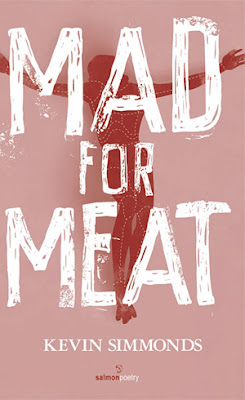
Microreview: Kevin Simmonds' "Mad for Meat"


In Kevin Simmonds' first book Mad for Meat, you can't help but feel the jumpy lineation of Sonia Sanchez and the condensed linguistic play of someone like Kay Ryan or Thylias Moss, especially in her earlier work like Small Congregations.  There's a healthy self-contentment in Simmonds' poetry which is missing from many of his peers' work.  Simmonds doesn't try to capitalize on phony urgency.

He is largely a talented poet of reminiscence, and it doesn't feel like its in any way a default position.  In poem after poem, he transports himself (and us) to intriguing places, like hearing Leontyne Price on TV ("the black fan of your voice/on primetime/Turbaned goddess of my Zenith/the way God struck your soprano..."); Emmett Till ("a mansion of a boy whose rooms we must fill"); Dolly Parton ("How did you know it was love enough/for a cinched waist and a blond wig/an alter of pentecostal breasts/and their rising hallelujah...).  His language is almost invariably fun and alive.

A few of the personae prose poems don't measure up to the rest of the book.  It feels occasionally like Simmonds doesn't know what he wants to say about them, or allow them say about themselves--he offers a series of facts that could be gleaned from a fine history book.  For example, in his poem "Bayard Rustin," Simmonds has Rustin present the obvious biographical facts ("The Movement.  That's what I work for.  The March on Washington for Jobs and Freedom.  It's going to make an impact.")  Which would be fine if it didn't  take him almost three paragraphs to arrive to the poetry: "Homosexual.  Such an antiseptic sound to it.  Yet I rather that to other names, names I'm called between my teeth."

This is a very minor flaw in a wonderful book full of tenacious "sequined despair" and the self-confidence that teaches us to "wait out the truth" through the protracted retelling of old stories.

Kevin Simmonds' Mad for Meat is available through Salmon Poetry.

Wednesday, January 25, 2012

Microreview: On "Nocturnal Omissions" by Gavin Geoffrey Dillard and Eric Norris


There's something inherently weak in a critic who refers to something as a "guilty pleasure."  You can't help but imagine what pressures are weighing on them to feel they have to qualify their liking in such a guarded way.  With Nocturnal Omissions: A Tale of Two Poets, Eric Norris and one-time porn star Gavin Geoffrey Dillard, have written a pseudo-autobiographical epistolary novel-in-verse comprised of frenetic, bawdy emails written during a two month period.  Why feel guilty liking it?

The book begins with the poem "La Fin de Temps" in which Dillard boldly declares his intentions: "I want to supplant your blood with my sperm and/plant a garden of teeth upon island and crest."  The next page features a response poem by Norris called "The Day of the Apocalypse."  Here's a sample: "I creep forward like the Earl of Gloucester in King Lear, smelling my way to Dover.".  And then Galvin's reply appears as the next poem "Petit Dejeuner au Lit."  One of the lines asks "...will a hot stream of piss be mine and a fleshy scone of rubicund jam?"

Nocturnal Omissions might be one of the more intriguing books of 2011.  Not quite camp, not quite comedy, it feels (sort of) like an extended in-joke-- except one that you do weirdly want to part of. Sometimes the experience is like watching a really amazing high-school variety show; it's sloppy, and you spend a lot of time simply admiring their gusto, waitng for them to stumble into the next fun bit. Sometimes it can take a bit too long to come, but you know it will.  This book is even as overlong as most of those shows-- as it should be-- part of the fun is their refusal, conscious or not, to conform through compression.  They feel entitled to their space and their excess, the thought of acquiescing to someone else's rules doesn't even seem to occur to them.  It's 165 pages, and you get the sense they wouldn't mind if you didn't go straight from beginning to end.  Go ahead and wander around.  Do what you want.

The pronouncements of love and lust ("But you, precious halfling, when you grin and dance before me, even the possums mumble how tasty you might be in a pie or stew") makes the humor endearing in an uncommon way.  You get the sense they're writing parody, or self-parody, or something reminiscent of an idea of parody, but you're not quite sure.  The call-and-response poems document the minutiae of gay life ("I wore a wife-beater out in public today, for the first time in some years--the diet has worked"), possibly sincere philosophy ("Love is a misnomer, for it implies duality, purports two disparate parts intertwined"), and critiques of well-known contemporary poets ("I do like dogs.  I detest Mark Doty.")..along with other things ("This week I had implanted my first bionic tooth--a titanium screw into my lower mandible; I have felt no pain...).

When you read lines like "Don't think me cynical if I find love incredible," you can't help but read this as a warning to the critic.  in fact, the book transforms itself into something critic-proof.  When they reference Sappho, Housman ("the best"), and Shakespeare, you don't feel the allusion are a nod to the audience, an insistence for approval, like the kind of poem the University of Chicago press goes ga-ga for.  It's thrown into the poem because they felt like throwing it in; they like books because they do, not because they should.

As Bryan Borland's still new Sibling Rivalry Press (already highly regarded) continues to take off, you can't help but hope he doesn't begin to only publish more mainstream authors, like the precocious Saeed Jones and the established Matthew Hittinger, but also takes in what ultimately be the more unexpected projects from people who don't seem to have MFAs or the most embarrassing sort of Ph.D. (yes, you can still purchase one in creative writing if your multiple-choice skills are intact.)  Flawed and wholly undisciplined as it may be, perhaps an integral part of its strength, the unstoppable joy of writing surfaces in Noctural Omissions, which is perhaps the most radical act of all.

Gavin Dillard's and Eric Norris' Nocturnal Omissions: A Tale of Two Poets is available through Sibling Rivalry Press.

Sunday, January 22, 2012

Microreview: On Neil De La Flor's and Maureen Seaton's "Sinead O' Connor and Her Coat of a Thousand Bluebirds"


Neil De La Flor's and Maureen Seaton's Sinead O' Connor and Her Coat of a Thousand Bluebirds is the kind of poetry book that most often never wins awards: it's too creative.  Their collaborative effort does something most authors working together don't have the gumption to do: refuse to tidy up their poems in a way that everything becomes seamless and you're left saying to yourself, "This poem feels like it's written by one person.  Everything is of a piece."  What's the point of reading a collaboration if it doesn't feel messy, busting open with too much talent?  Why believe less is more?  Sometimes more is more.  For good reason.

The rambling, blessedly moronic litanies are obviously perfect vehicles for collaboration.  They makes lists and a lot of other things.  You can imagine a pair of poets trying to outshine the other as yet another burst of creativity jettisons its way through the Internet.  However they divvied up the work for their collaboration is ultimately irrelevant.  What matters is the end results, and this book is so wonderful.  Take a look at some of the zingers.  Here's one from "Metempsychosis": "I believed ellipses were Lilliputian prints of panini recipes"   Another from "Words of Mouth": "They say Beethoven's maid died of lead poisoning.  If she ate paint, it would be a thread of gold through turquoise, swan's blood, a violin silence." Or the entirety of "The Archaeology of Christendom": "The sorest spot on my head is a temple./I have bra cups in multiple sizes."

These brilliant comics know every joke is ultimately a throwaway, every poem a vehicle for urgent nonsense. 

Neil De La Flor's and Maureen Seaton's Sinead O' Connor and Her Coat of a Thousand Bluebirds is available through Firewheel Editions.

Saturday, January 21, 2012

Microreview: On Andrew Demcak's "Night Chant"


Consciously oppressive and morose, Andrew Demcak's new book of poetry Night Chant labors to create what could in lesser hands seem like a queer rewriting of Sylvia Plath.  Demack knows better, although he, too, creates a dreary atonality through intriguing word choices.  Often the work he does here feels strained, but in a good way; he doesn't want any of his triggers to produce a baldfaced narrative.  The titles of his poems --"Rent Boy," "Crossing the Water," "Troll," "Child Killer"-- seem irrelevant; they feel like a random noun someone uttered to rev Demcak up to show his skill.  And there's more than a solid amount of ability here.

For a significant portion of the book, Demcak strains to deconstruct a noun, and then asks us to help him reassemble it.  In the better poems, we feel the labor of that strain--the diction and metaphor pushing the subject in a way that force it to become something one can perceive as new.  Here's some of the fun play in the personae poem "Oedipus Rex": "His lips had lost their sphinx,/ that tired jinx, that nag./...Midnight's middle was not an empty room./My cock was the answer to the riddle."  Or the curiously askew final couplet in "Orgasm vs. Rainbow": "Orgasms are bluster, quick mouthfuls, ogling eyes./But you have rainbows for days after denouncing the clouds."

Occasionally, he doesn't feel like he's straining quite enough; he doesn't deserve the release.  For example, in the less striking poem "Eros": "Inferno, bright flame, the spasm of flesh./ Halos blazing sparks ignite: orgasm."

Demcak's book sometimes feels over-long (close to ninety pages); the exertion required for reading such a lengthy book feels slightly greedy, especially since some of the poems like "Mirror at Forty" and "In Solitude" could be easily edited to highlight some of the best like "Eavesdropper, 1990" and the daring "Mishima Fantasy.".  But still, it's hard to find any place in the the book where there is anything that resembles "a merciless desert here, this page."

Andrew Demcak's Night Chant is available through Lethe Press.

Friday, January 20, 2012

Microreview: On Hansa Bergwall and Timothy Liu's "The Thames & Hudson Project"


You could say that Hansa Bergwall's and Timothy Liu's chapbook The Thames & Hudson Project is the best chapbook explicitly fashioned out of a queer mid-life crisis.  As they declare in the prose polemic that begins their project: "...the notches left on your belt that once made for salacious stories to aggrandize tumescent vanity feel less consequential as your body ages, as the face you greet each morning in the morning no longer speaks to the who and the what you've been for all the men you've dallied with, even written about."  In one of the most painfully beautiful poems, "You, Under My Window," we see a presumably older narrator who finds a vitality in the search for a space relieved of solipsistic desire as well as a cowardly acquiescence to the beloved.  The poem begins: "The oak turned red while you sung./How boring."  It leads to a final couplet which reads: "When my wrinkles/smoothed and my nose pugged, I ceased/being me.  Go ahead and make love/to your magic.  I am not there."

In so many vital ways, this is a book obsessed with ethical compromise.  It's elegantly instructive in how a poet can explore restlessness within the lyric: the relationship between the "I" and the "you," sex and the lust, reader and writer.  Always self-reflexive in their own deliberately melodramatic illustration of the erotic, the authors avoid easy thematics.  From the poem "Without You," the poets write: "Without you I am the diorama's/glassed-in air, the dew drop/that never falls into a time lapse photo..."  Cagey and open-hearted at the same time, Bergwall and Liu disclose their dissatisfaction with unchallenged, plain depictions of homosexual lust and sex.  What they come up is not so much solutions, but a relentless, and often comic, inquiry into the gay lyric, never losing sight of what may, in the end, be the most necessary imperative to the poet and reader.  As they write in the poem "Under Your Window, 3 AM: "Do as you will./I am here/to serenade you."

Hansa Bergwall and Timothy Liu's The Thames & Hudson Project is available through Fields Press.

Thursday, January 19, 2012

Microreview: On Charles Jensen's "The Nanopedia Quick-Reference Pocket Lexicon of Contemporary American Culture"

Almost feeling like a game of Tetris, there’s a lot of fun in watching Charles Jensen shift and slide the sounds and meanings of words in his new chapbook, The Nanopedia Quick-Reference Pocket Lexicon of Contemporary American Culture. With suaveness, Jensen manages to create puzzles through prose poems that wind up feeling as solved as an aphorism and as open-ended as a sweet riddle.

One of his best, “Reaganomics,” begins: “The color-coding trends toward the blue collar.” It ends with bleak comedy: “Dollars trade hands. Those young boys take one for America. It’s a chaos theory: a butterfly flaps its wings in Beijing; a moving car blowjob goes suddenly, horribly wrong.” Indebted to Stephen Dunn’s Riffs & Reciprocities: Prose Pairs and James Richardson’s Vectors: Aphorisms & Ten Second Essays, Jensen refuses those authors’ flat diction which always verge on sounding like a USA Today article.

Here’s where “Frenemies” begins: “Tragedy makes the shape of an O with his mouth and sooner or later, you know some teenage boy thinks, Round peg, round hole. Here’s where the same poem ends up: “...everybody loves a loose Tragedy, but comedy doesn’t get near enough play. The difference between Hamlet and Hambone.” Serio-comic, Jensen’s chapbook reveal a great aptitude for the making of worthy prose poetic games.

Charles Jensen's The Nanopedia Quick-Reference Pocket Lexicon of Contemporary American Culture through MiPOesias.

Friday, December 23, 2011

The Holiday Spirit of Kindness and Goodwill.

Maybe the holidays are the time for cruel behavior and unexpected lashing out at attempts at cheerful comradery.  Scrooge telling carollers they should be boiled in their own pudding and the like. I guess my unwanted holiday gift was being blindsided by a particularly unexpected mean-spiritedness.  The only thing that was unusual was that it was by another gay poet --one I respect and have vigorously supported in the past.  I wouldn't address this at all, except for the fact that I've rather cruelly been placed in a public position where I have to defend myself somewhat not on terms of my art but on terms of the personal. 

For me, Facebook is an opportunity to be silly and also to convey messages in an expedient way, especially when you're bored and have nothing much to do (like the holidays).  For three years, I've had a congenial correspondence with a certain poet.  In those three years on this blog, while I more often spend time promoting and praising interesting and new gay poets (as those who actually read my posts rather than skimming them for negativity or taking someone else's word for what I do here will know), but I've sometimes written reviews of books where I found them middling to fair to not-my-cup-of-tea (note, that's the books or poems, not the authors themselves--  I don't write about people who don't in some way interest me or who I respect, even if I don't always personally like every single piece that flows from their pen). Over that time, this person wrote me a number of responses, often affirming my decision to do so, in both personal emails and Facebook messages.

A few days ago, though, I wrote a status update in which I joked that I was bored and that I needed to get off Facebook or I would start "harrassing people."  He wrote comments on my Facebook account which encouraged me in a charming way to stay on and that I should do so (i.e., my joke about "harassing" people).  It was a fun thing to see.  Then afterwards he wrote as a status update on his account saying that he was drinking a glass of wine, and I said tongue in cheek, "I bet it's white, faggot"--offering what I felt to be a camp (if tired) response.  In case it's not obvious, I'm not a straight person, nor a high school jock bullying Kurt from "Glee," nor Tracy Morgan threatening to stab his gay son in the head. While there's a definite debate to whether gays (and other minorities) should comically "reclaim" slanderous words, it's hard to imagine that the context wasn't absolutely clear. In fact, there's a long history of prominent gays reclaiming such words comically. The name of this blog is even "Pansy Poetics."  Perhaps there's a silent contingent that feels that title's also "going too far" but in three years I have yet to hear from them, including this person who suddenly wishes to publicly chastise me as some sort of bigot.

Anyway, this person who I thought I was on good terms with said that his wine was indeed red.  Later on, we joked about something else.  I was never told during the actual conversation I was out-of-line or that my throwaway mock-Boys-In-The-Band moment offended him; if I had, I would have deleted it in a heartbeat and apologized. I don't go around spewing the word "faggot;" it's generally not my style of "camp" even if I feel like being camp.  Yesterday, though, a handful of people suddenly started writing me that this man was upset at me for some reason, and was making an issue of it on his Facebook page.  Not knowing what was up or why, I looked on his Wall and found out that I was indeed mysteriously de-befriended.

This person never wrote to me directly and said what's up.  Nothing.  Instead, I heard reports that he posted a slur on me on his account publicly stating that I "had gone too far."  Using the word "faggot," he apparently now said, was way beyond the pale for me, so, goodbye, get lost, sayonara.

I was (and still am) hurt that if he was offended he didn't just remove the post and privately tell me he felt it was misguided.  I'm not claiming we were best friends or anything, but, really.

I wrote him a response saying that I was sorry, that I thought we were being silly, and why did he not write me before he took a drastic action.  No response.  I wrote him again and gave him my phone number and said we should talk on the phone.

All I got was an email saying that I didn't know him as a person, and that word was unacceptable. His account was not a "gay bar."  It was a space for him to do professional work, among other things.  I was an interloper.  He would not change his mind.

But it's my career, too, after all.  And publicly charging me with bigotry and "going too far" while blocking me from being even able to defend myself at the source doesn't seem to me like the most "moral" or responsible behavior, either.

Needless to say, I am very hurt.  But I am not writing this post really to document this exchange, but instead to use it as a vehicle to address a concern about how some otherwise well-intended gay men cruelly marginalize others under the guise that they are acting in a moral fashion.

Any undergraduate from a Queer Studies 101 class could tell you that sometimes marginalized groups of people take back derogatory words by using them themselves--the pink triangle, for instance.  "Dykes on Bikes."  The term "Queer Studies," itself. Openly gay comics like The Kids in the Hall's Scott Thompson would go out of business overnight if the word "faggot" was verboten to gay men. Etc., etc., etc. And obviously, the role of camp comes into play, especially when talking about something as petty as drinking. 

When people have objected to something I've written it's almost always been on these grounds: be polite.   The unmistakable desire to protect middle-class etiquette is a result not of good manners, but a desire to protect the status quo, to ensure that insiders (whether it's schools, presses, aesthetic decisions, etc. etc.) maintain their control. Are we sure this isn't itself a type of homophobia-- the "behave yourself" and act like the "good" gay man? Maybe someone doesn't want profanity on their website, fair enough.  But it's the impulse here to take it farther than addressing it when it happened, removing it, and contacting me privately about it that bothers me.  Instead, it was a public upbraiding; this is what happens when you step out of line.

I'm not going to belabor the obvious, at least not here (too late, you probably say).

What shocks me in this particular case, though, is this person has almost everything one could ask for in terms of their poetry career, but suddenly feels the need to take a friendly conversation and use it to meanly clobber a friend who's an  insignificant poet with an admittedly obscure blog over the head.  There is so much fear about saying anything "negative" that the community shuts down.

I find it shocking when some gay poets claim that they don't believe in criticism, that (as I sometimes get leveled at me) critics are by their very nature just jealous writers.  My huge question to these people is, how many people are actually doing reviewing these days?  I sure as heck don't get paid for it, nor am I giving Poets & Writers a run for their money in terms of readers.  I do it because I love it, and maybe someone, somewhere might discover a work by a gay writer they hadn't seen or considered or get jazzed by discussing the merits of an established poet's recent works. And why on earth does one become a writer, if one doesn't want people to give you their take?  I feel writers want to share the excitement of finding what's new and intriguing, and sometimes discussing what doesn't work and why.  I'm not sure why anyone who just wants eternal positivity and praise should be a writer, rather than, say, becoming a cult leader instead.

I think that the reason some gay poetry can seem so homogeneous (and I will boast that I've read as much gay contemporary poetry as anyone, from the "big" books to the small ones I'm constantly seeking out, sometimes being one of the few adding to online bookstore's sales numbers) and that that's why the same aesthetic decisions and lines of inquiry can sometimes feel so much the same.

When I first started my blog, I was recovering from a serious, near-fatal depression--I needed to find ways to be more active in my attempts to find community.  I think that a lot of people are too cynical about social media.  I have found over the years that Facebook, for instance, has enabled me to be friends with people that I otherwise never would have met.  Starting a blog about queer poetics also introduced me to a slew of gay men who were now people I was corresponding with.  When I was depressed, it was about the same time I published my first book; for some reason, I felt words didn't matter.  They didn't yield anything.  Connecting people in such an immediate and expedient way restored that faith.

I never expected anyone to read the blog.  Why would they?  All I was doing was writing about books of poetry by fellow gay men.  I quickly found out when I shared an ambivalence about a gay poet that people do read a blog.  I know from the Sitemaster that my blog has been read by more people than anything else I've ever written.  That's not saying much, but, hey.

When the blog began, almost immediately, I received angry emails from gay men: how dare you criticize other gay men?  There's more than enough people already against us.  I could talk about which works I liked and loved and was happy to discover all I liked until I was blue in the face, but if I said something negative, it got all the attention, emails, comments, etc. Rarely did some of these responders want to discuss the specifics of a particular criticism if there was a criticism in a review, but instead wanted to talk about what a "negative" person I was being.   Regardless, for me, open discussion has always been a good thing.

To come full circle, for what it's worth, I said a lot of good things about this poet who won't now talk to me.  I felt though the need to make myself transparent, and thought that it would be more conducive for myself and the queer community, whatever that is, to provoke and get a more genuine conversation going.

Over the years, I have found out a number of things.  Once I made an attempt to read all the Lambda award nominees in Gay Male Poetry--I corresponded with the poets who were up for the award.  It shocked me that many of them said they hadn't read any of their competitors' books.  Wasn't anyone simply curious?  Instead of criticizing one another in a circa-1970's style circular firing squad conversation about the pros and cons of minorities "reclaiming" slurs like the F-word, why don't we encourage everyone to support our gay literary community by genuinely buying, reading, and actively and energetically discussing the works?

Needless to say, as if it bears repetition, how much I am dismayed that someone who I've talked to over the years, sent emails to, received emails back from, talked about other poets with (the same poets I wrote about publicly) but would just cut me loose over a dumb joke that might as well be gathering dust in the eight-million- gay-men-have-used-variations-of-it hall of fame.

I don't think that's the crime though.  In past emails he said that he wanted to hang out with me at AWP, but he said, jokingly, it might "hurt" his reputation.  If one wants to talk about a degrading, demeaning, and inappropriate "joke," one might start there. What did I do that I'm a risk to someone's reputation?  I kept a blog documenting my opinions about gay art.  (And I buy all the books by gay poets myself.  Only four times in three plus years did I receive a copy, and even then, I always made sure to buy yet another copy to support the press.) 

The fact that an unknown poet like myself could pose a threat shows how bad the situation is.  I've always wanted to be a part of a community that provides checks and balances to one another--why else write about other books? Anyway, sorry if I've inconvenienced anyone's reputation.  To paraphrase Scrooge, perhaps I should just be de-friended and decrease the surplus population.

Happy Holidays!

Friday, December 2, 2011

On the Lambda Literary Awards, Saeed Jones, Aaron Smith, and Glenn Sheldon


Dear Mr. Richard Labonte,
 
I recently read a mass email that you sent out, saying that you extended the December 1 deadline for submissions to the annual Lambda Literary Awards.  You reported that you would be contacting publishers who you thought had worthy entries.  There are three poetry books that I feel need to be entered.  I am afraid that because they are chapbooks and not full-length that their publishers might feel reluctant to enter them.  Chapbooks are often marginalized and often unfortunately seen as merely a gateway to a full-length book.  I feel that they should be considered as a self-contained product.  That's why I believe Sibling Rivalry Press, Winged City Chapbooks c/o. New Sins Press, and Rocksaw Press should be contacted.  They each produced a fine chapbooks that I feel could easily become a finalist.  The three chapbooks include Saeed Jones' "When the Only Light is Fire," Aaron Smith's "Men in Groups," and Glenn Sheldon's "Biography of the Boy who Prays to the God of Foreheads."  Please don't marginalize chapbooks.  (If Frank Bidart's chapbook "Music Like Dirt" can be a finalist for the Pulitzer surely these chapbooks could be at the very least considered for a Lambda.)  Immediately below are my microreviews of these works.

                                                         ***

Much anticipated, Saeed Jones’ chapbook When the Only Light is Fire lives up largely to its hype, particularly the first half.  Stand-outs include the personae poem “Kudzu” (“And if I ever strangled sparrows/it was only because I dreamed/ of better songs”) and “Boy Stolen Evening Gown” (“I waltz in an acre of bad wigs.”)  His deftly compressed series of poems about the murder of James Byrd, Jr. act as an affirmation and a successful extension of Lucille Clifton’s famous work, “jasper texas 1998”  Who could forget her line: “I am a man’s head hunched in the road./I was chosen to speak by the members/of my body.”?  Here on his own terms, Jones writes with a similar defiance in “Jasper, 1998: I”: ...”but I speak/(tongue slick with iron)/but I speak/in the language of sharp turns.”   His very few less successful poems deal with bad sex, jilted lovers, dark lonely nights.    There, he ditches his technique, strong line breaks, sharp turns of phrase, for baroque setting.  Take the poem “Room 31”: “Cigarette smoke/is the smell of the last couple here,/the ghost of their stains/still/on the sheet,..”  More of a sign of youth than anything I bet, these minimal, disposable scenes will be replaced no doubt by more earned and honorable sadness.  Regardless, don’t miss out on this exciting debut.

Saeed Jones' When the Only Light is Fire is available through Sibling Rivalry Press.

                                                   ***

I was not a fan of Aaron Smith’s first book Blue on Blue Ground.  It felt canned and amateurish. (“There’s a different kind of loneliness/in the city, one of thousands of people rushing away/...and streets that at night are forbidden like desire.”)  Over the years, I’ve been reading his new work online, and have been awed by his transformation into one of our more accomplished comic poets.  One of my favorites is his inspired rewrite of  Berryman’s Dream Song 14, “Life, friends, is boring.”  Here’s an excerpt from the poem called “Open Letter”: “Your choice of socks is boring.  (So is the way you walk!)  You eat boring bagels with butter (not cream cheese) and your breath reeks with boring, boring coffee and morning stink.”  Not only here, but in a number of other places in the book, he proves himself to be the master of the parenthetic expression, using them to provide an odd, inspired sincerity.  The closure of the poem “Hurtful” reads: “...I hate you/more for: That you can eat French fries/and not exercise.That everyone you let/be close to you has to need/you.  Strangers gawking/because you’re radiant (and you are radiant!)”  By far, my favorite poem in the book is “Diesel Clothing Ad (Naked Man with Messenger Bag)” which is essentially an ekphrasis at heart: “So what if the woman’s hand reaching/for the bag pulls the bag/back and we see his dick,/that one ball hangs lower/than the other,that he shaves them.  So what.  So what..."  The poem continues to use stanza breaks, spacing, and anaphora to embody the motion of the bodies in the actual ad.  The only criticism I have is his unfortunate use of the second-person from time to time.  Smith is too gentle a poet to succeed in such a control move.  You can feel him overextending, which results in a cuteness and an unsuccessful sadistic gesture.  We don’t want to live out his occasionally frivolous clichés.  From his poem “Lucky,” Smith writes: “Who knew they’d punish you for knowing/your turquoise shirt went perfectly/with black sweatpants and turquoise/Chuck Taylors?”  All in all, Smith’s chapbook is full of some of the most inspired comedy of the year.

Aaron Smith's Men in Groups is available through Winged City Chapbooks co/New Sins Press.

                                        ***

 
Admirably eerie, at times angry, and other times necessarily sentimental, Glenn Sheldon’s Biography of the Gods of Foreheads freaked me out in the best sense.  In this current, troubled moment of history, we often overlook the power of allegory.  Only a poet as skilled as Sheldon can triumph over ‘war-worn amnesiac bats.’   The book is divided into six sections, each one revealing more nuance to his inquiry into youth, artistic process, and an abstracted politics.  Unlike so many books of poetry, Sheldon refuses to write flat journalism.  The book feels influenced by someone like Jeanette Winterson, blending a sort of magic realism with unrestrained metaphor.  As Sheldon writes: “The boy’s attic shrinks into the space of this poem, still size of a room with green flourishes of jungle,/industry of generational anarchy./The pages are  chiseled...”  By the end, the boy finds himself: “Deeper into himself but flying higher, desired/as an image to be stained in glass, he occurs:/epiphany of currency and blood’s sexy blues.”  Sheldon’s words are never ‘too fast, too flung,’  His words and the ‘fantastically small spaces between them’ broke my heart-- and mended it, too.

Glenn Sheldon's Biography of the Boy who Prays to the God of Foreheads is available through RockSaw Press.

Saturday, November 26, 2011

Reviews of Christopher Hennessy's "Love-In-Idleness" and Jee Leong Koh's "Seven Studies for a Self Portrait"


Cautious, sometimes overly so, Christopher Hennessy's Love-In-Idleness seems influenced more by the fixed knowingness of Alfred Corn's poems than the loony spontaneity of Wayne Koestenbaum, even if he does seem more invested in the latter.  Referencing everything from Nietzche to Linnaeus, from Icarus to Gethsemane, it doesn't take long to realize that "Love-In-Idleness" employs a politics of academic elitism to push his book forward.  This isn't meant as a criticism; in fact, quite the opposite--it often grants the book an appealing old-fashionedness.  In a poem entitled "A Split Secret," posed as the story of St. Sebastian's lover, you can get the sense of Hennessy's finely crafted verse.  An archer hits St. Sebastian with an arrow, which causes his lover to remark on his beloved's physical body.  The lover pontificates if the martyr is beautiful "Even now?/Even branched/with arrows, skin bleached/but with a constellation/of red puncture ticks/Yet so little blood...And martyr is an ugly word--/a split secret, a coward's thumb.”  In another poem, “Ghost Boy,” also ostensibly sincere in its intentions (perhaps even autobiographical?) Hennessy writes to his father: “I’m left imagining a grim-faced child pressing the ghost/of his palms against the glass/a boy who sees the rumor/of his future in the black glass.”  Surely, if you talk to older gay poets, many would tell you that they felt compelled to embed their writing with classical and Biblical allusions.  Bias against gay material allowed, to an extent, for them to tell their own unique story as long as they affirmed that they weren’t going to ditch canonical touchstones in the process.  Now, with some civil-rights advancements, the compulsion seems to be a lot less overwhelming.  It’s pretty much a choice. And Hennessy proves he's able to use both the past and the contemporary to successful lyric effect.  Look at the firm, even if slightly too comfortable, ending from “Icarus on the Moon”: “...I’ll be seizing/ecstasy, a flying wild man—no one’s son./  No gravity.  Only libido, my breath causing/new eddies of atmosphere.  The moon-so close-/like all things desired, more or less there.”  Now admire the truly great final lines to the poem  “Blood in the Cum,” which takes the time to define its own title as “the scarlet ribbon/in an egg’s albumen, a mistake of embryonic petals/coiled at its center.”  Hennessy might occasionally approach his material in a tentative way, but his poetry reassures us that he has the ability to travel where he chooses next. 

Christopher Hennessy's "Love-In-Idleness" is available at Brooklyn Arts Press.


                                                                  ***

One of the most ambitious and overlooked book of this year is Jee Leong Koh’s Seven Studies for a Self Portrait.  Even though presumably autobiographical, don’t expect any mushy confessions here.   As good as anything I’ve read this year, Koh’s poems are curiously distant... but in an enticing and exciting way. The true excellence of the book is contained in a long poem called “A Lover’s Recourse,” a homage to Roland Barthes, stretching for forty-eight pages, written entirely in ghazals.  Tracing his relationships with lovers, the father, and his own writing process, Koh never resorts to easy theatrics but to open-ended imagery: “Love is not a house.  It is always on the move.  What does a lasso have in common with a house?”  And: “What is this world?/A ship or a shiptearing rock?/And does the lighthouse look anything like the sun?”   Like his peer Rigoberto Gonzalez, he regularly inserts a peculiar word to upset what may seem like a more ordinary image (although there is a more ferocious velocity in Gonzalez's poems.)  Here Koh does it with the word “itch”: “I hope perfection does not lie in quietness./A poet builds his house in the fading of a bell./The fading is a fault but silence is an itch./Most endurable, Jee, is the unrelenting bell.”  There’s a somberness that pervades the book that feels inherently risky; its confessions are checked with measured images and an eerie equanimity.  His obsessions are clear and multi-layered.  You don’t have to look much further than the trope of the pigeon, which moves consistently through the long poem and the book in general.  From “A Lover’s Recourse," the following lines appear: “He does not wish to choose between a dove and a dove./In Jee’s ribcage contracts the muscle of a pigeon."  In a shorter poem with a strategically overly familiar title “The Pigeon,” Koh reaches the graceful end : “This is not a rat ironed flat on the road.  This is/a pigeon.  See the white fluff still not completely blackened. Affixed to the ground, the animal ruffles the light./Hard to tell the difference but it is a pigeon./Hard to tell the difference but it is still bright.”  In yet another completely different poem, ”Unless,” Koh travels toward his obsession: “Every face is a closed door.  Every tree is a curtain./The smallheaded pigeon brings no message to me./The bright air gives way but doesn’t give entrance.”  Intriguingly unobtrusive and obsessive at the same time, Koh’s book grasps the sublime as any other book I've read lately.  I truly hope it’s found by more critics as the end-of-the-year retrospective lists are announced, and prizes awarded. This book deserves attention.

Jee Leong Koh's "Seven Studies for a Self Portrait" is available for purchase at Bench Press.